Spiritual capital refers to the human and social resources within a church that enable spiritual life to flourish. Spiritual capital is an attribute of a church, an organised group of believers. By contrast, spiritual life is an attribute of active church members that affects the church’s growth and decline dynamics. It captures those particular works of God’s Holy Spirit that make believers more effective in the conversion of others and in building their spiritual life.
All organisations build human and social resources to enhance their organisational functions. Spiritual capital refers to those resources that assume the existence of God and other supernatural phenomena to justify their production. Examples include corporate worship, prayer meetings, Bible studies, and outreach activities such as evangelism.
See Spiritual Life in Dynamical Modelling for more discussion on spiritual capital and its relationship to spiritual life.
The Spiritual Capital model extends the Spiritual Life Model, which itself extends the Limited Enthusiasm Model with Activists.
Modelling Spiritual Capital
I assume that the active believers and enthusiasts in a church are largely responsible for building spiritual capital. These people are spiritually minded and willing to resource worship, prayer meetings, and similar activities. Their work is generally proportional to their numbers.
Spiritual capital is an accumulation that persists over time. For example, if activists begin discipleship training, it will continue as long as there are enough activists to support it. However, since spiritual capital naturally decays, maintaining activist numbers is essential to sustain its production. If the number of activists decreases, spiritual capital also declines.
I assume that the primary role of spiritual capital is to produce a higher balance between active and inactive church members. In the context of the Limited Enthusiasm Model with Activists, this effect is achieved by linking spiritual capital to the fractions of converts who become active and enthusiasts. I will include further effects as the model develops.
Both spiritual life and spiritual capital are built by activists but serve different roles. Spiritual life, a divine work, depends on God using activists, while spiritual capital, a human effort, offers structures for spiritual growth. Spiritual life influences conversion rates, whereas spiritual capital affects church quality, balancing active and inactive members.
System Dynamics Model
There are two hypotheses connected with spiritual capital and spiritual life.
- Spiritual Life Hypothesis. The church generates spiritual life, which in turn enhances the number of conversions within the church, loop R1, figure 1.
- Spiritual Capital Hypothesis. The church generates spiritual capital, which in turn enhances the quality of the church’s conversions. Higher quality means a greater proportion of enthusiasts, loop R2, and activists, loop R3, Figure 1. These proportions models the discipleship of new believers.
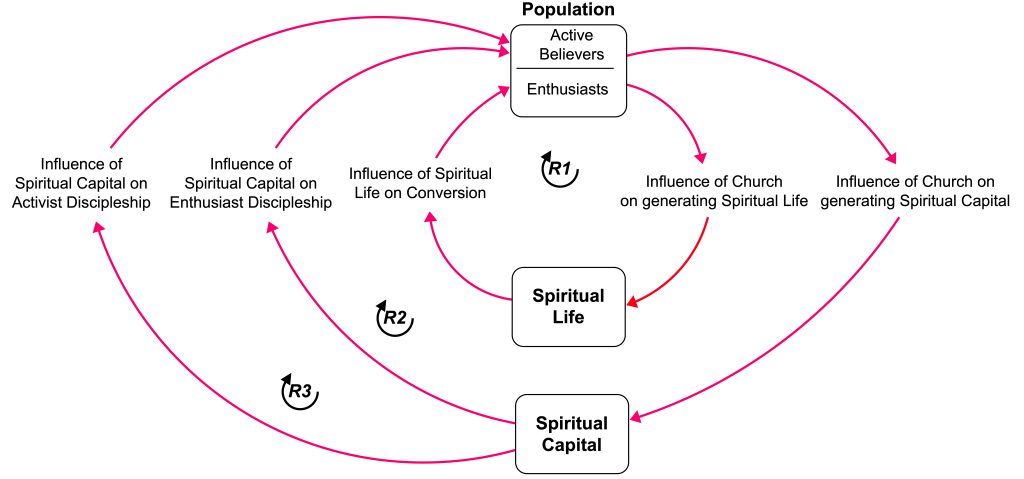
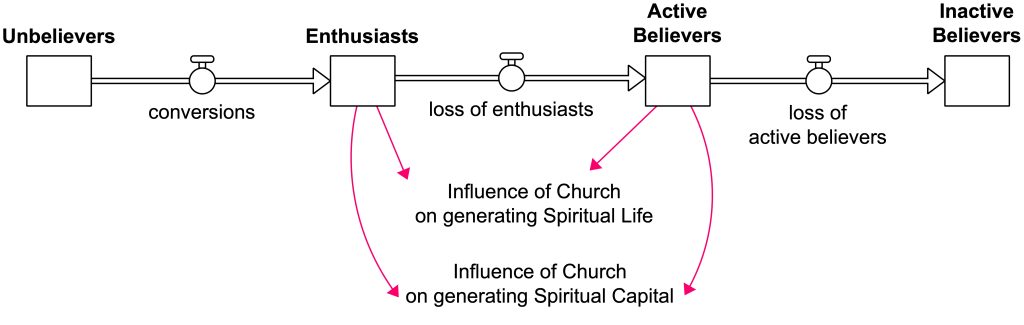
Figure 2 outlines the church growth model in the population module, Figure 1. The combined strength of active believers and enthusiasts generates spiritual capital and the spiritual life of the church. Enthusiasts are the active believers who are responsible for conversions.
Models of Spiritual Capital and Life
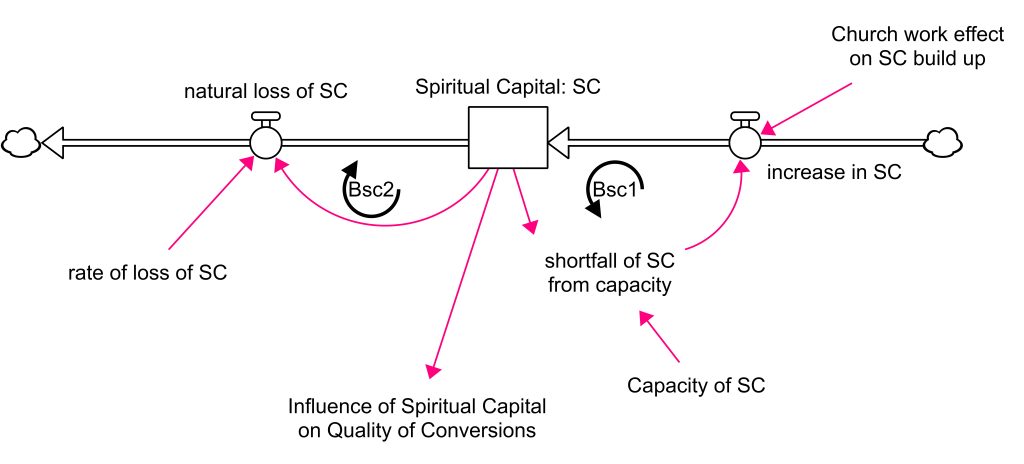
Both spiritual capital and life are modelled on a scale of zero to one using a single soft variable. Figure 3 shows the model of spiritual capital.. Balancing loop Bsc1 prevents the variable from exceeding its capacity of unity by making spiritual capital harder to produce as it approaches capacity. If the church fails to produce spiritual capital, perhaps due to insufficient activists, then the capital naturally decays, loop Bsl2. A church needs to actively maintain its spiritual capital; otherwise, it will fall away. The stock flow model has the same structure as that of spiritual life, but its parameter values and their meanings differ.
The model for Spiritual Life is similar. Its details appear on the pages Spiritual Life through Activists Model and its detailed assumptions.
The page, Spiritual Life in Dynamic Modelling, compares spiritual life and capital with their sociological equivalents.
How Spiritual Life and Capital Affect Conversion
Spiritual life has a direct influence on the enthusiasts ability to reproduce more enthusiasts by conversion. This process is modelled by feedback loop R1, as shown in Figure 1. The more spiritual life, the greater the conversion potential of the enthusiasts. The result is more enthusiasts and activists and hence more spiritual life. Figure 4 outlines the link from Spiritual Life to enthusiasts and activists.
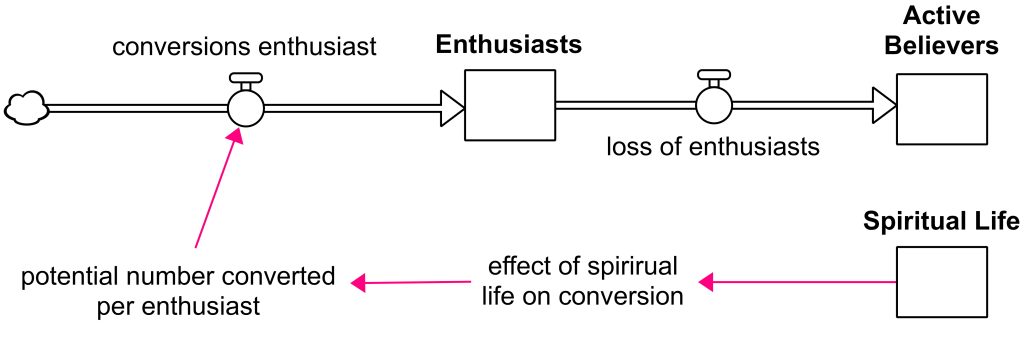
Spiritual capital has no direct effect on conversion. However, both Life and Capital effect the quality of conversions, that is how many converts become enthusiasts, active or inactive.
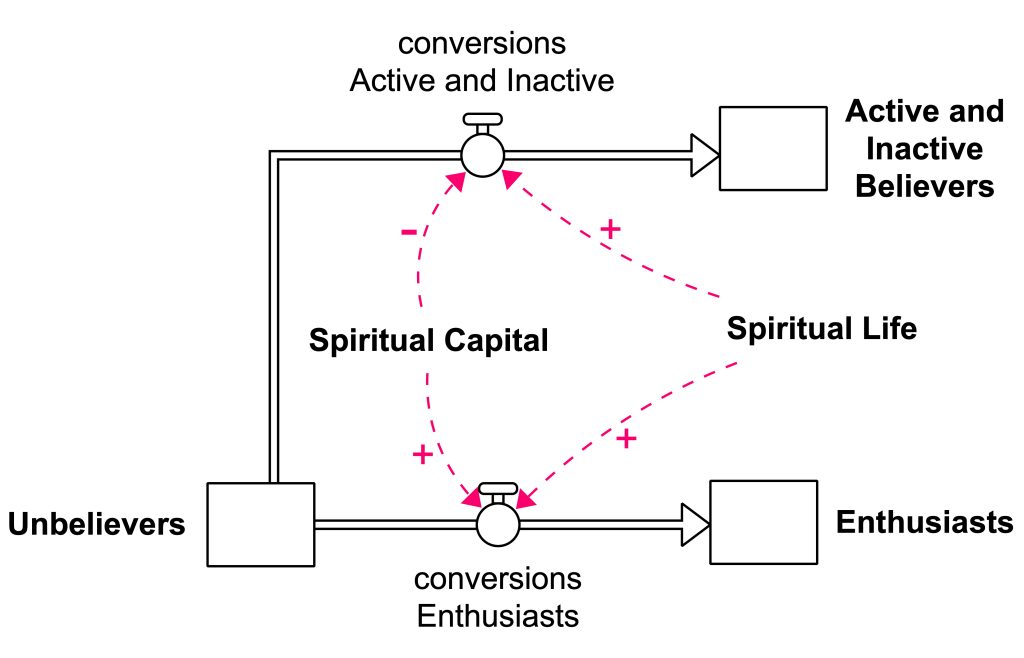
Spiritual life enhances conversions to enthusiasts, as well as active and inactive believers. However, spiritual capital only enhances enthusiasts at the expense of diminishing the other categories, Figure 5 (negative link from capital to active and inactive flow). This process represents discipleship aimed at enhancing enthusiasts.
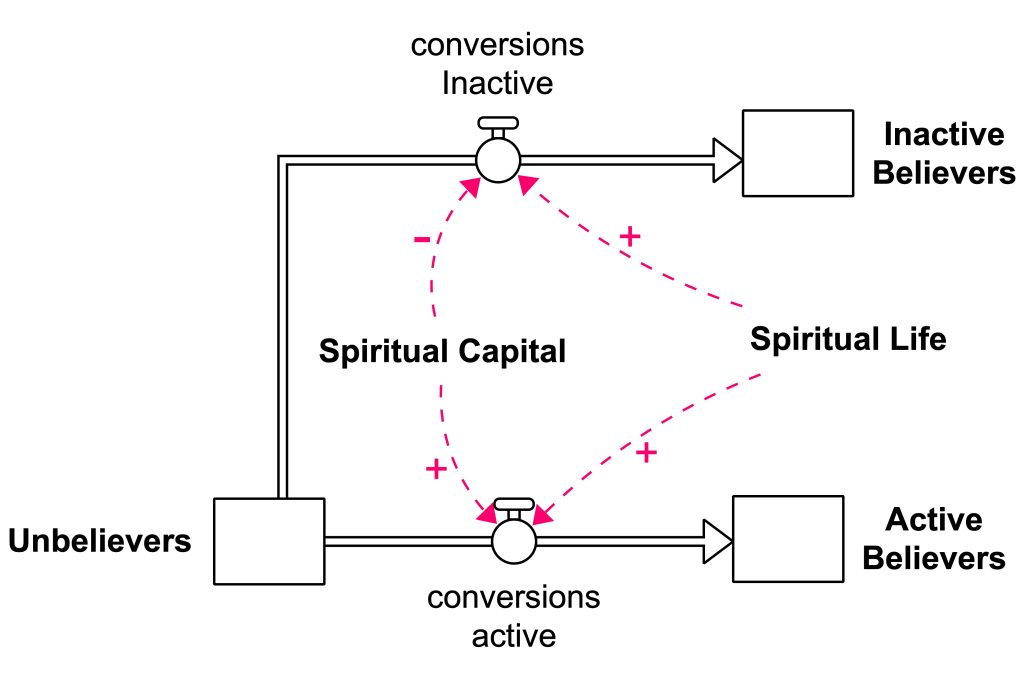
Likewise, there is form of discipleship that enhances active believers at the expense of inactive believers. Figure 6 describes this process with spiritual capital having a positive link to active believers and a negative one to inactive believers. Spiritual life enhances both.
Spiritual capital has a similar effect on how many existing enthusiasts progress to active believers as opposed to inactive. That is, the more spiritual capital, the more the loss of enthusiasts in Figure 2 flow into Active Believers as opposed to Inactive Believers (flow not shown).
Scope of Applicability
The model can be applied to an individual congregation or a national denomination. I also intend to use Spiritual Capital in a more comprehensive model of the rise and spread of Christianity over many centuries and its competition with other religions and ideologies. This comprehensive model is a long-term modelling project that will require additional features. In my models, spiritual capital is only used in conjunction with spiritual life.
Results of the Spiritual Capital Model
Imagine a church in revival starting with no spiritual capital. Perhaps it is a church formed by people who have split away from an existing denomination, or a new church plant in a different area. Figure 7 shows a rapid rise in spiritual capital from scratch as the activists build new spiritual structures in the church. Spiritual life also rises through the Holy Spirit’s reviving work. However, the church does not initially grow, as it takes time for newly enlivened enthusiasts to produce new enthusiasts and increase conversions.
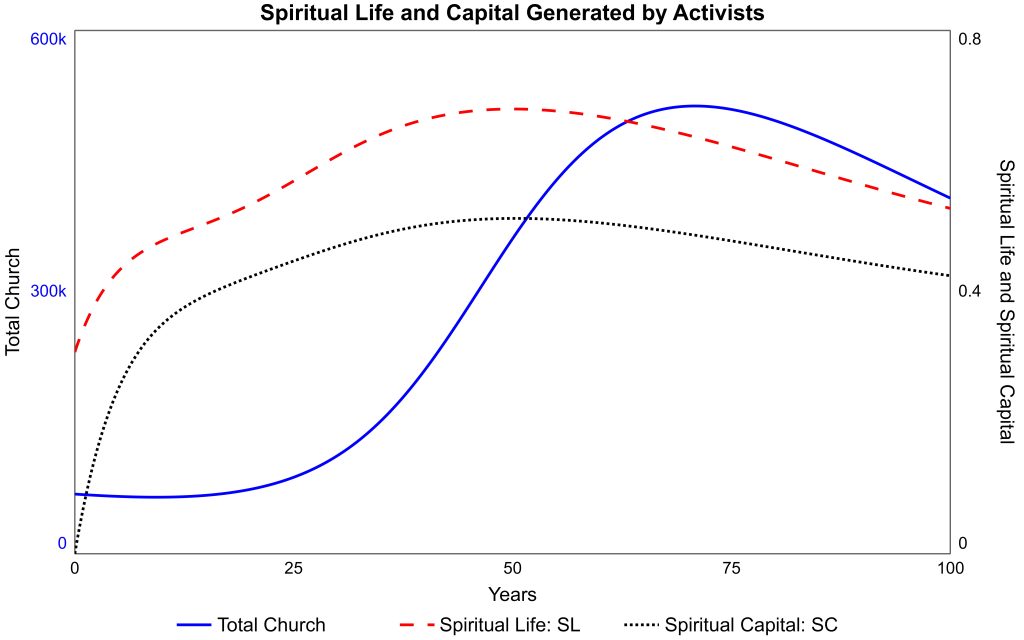
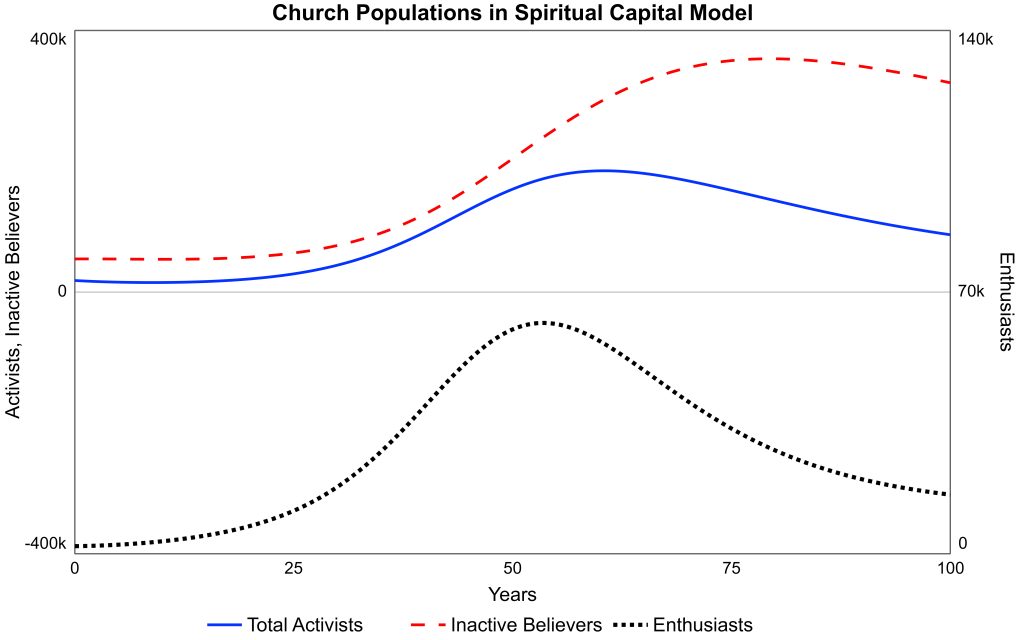
Figure 8 shows the slow rise in enthusiasts and the even slower rise in activists. Although spiritual life and capital increased quickly, it takes time for the Spirit’s work and the new spiritual structures in the church to produce more enthusiasts. The feedback loops R1, R2, and R3 involve two or more stocks that impose a delay on the accelerating effects of these loops. Thus, the church’s growth is delayed (Figure 7). Once the production of enthusiasts increases (Figure 8, about 30 years), church growth accelerates (Figure 7). As activist numbers increase, spiritual life and capital are maintained for much longer, extending church growth.
New churches need to be patient and allow time for the work of the Holy Spirit to take hold and for the church to put in place the appropriate spiritual structures.
Missing Features
The Spiritual Life model is not intended to be a complete model. Other features are not for a comprehensive church growth model.
- Institutionalism. The large churches develop institutional structures that support their size and complexity but take resources away from the mission. The result slows the effects of revival growth and its spiritual life. See the Institutional Model.
- Concern. When the spiritual life of a church declines, some people become concerned and take action to improve the church’s life. Revivals often start with people concerned about the spiritual state of the church.
- Legitimacy. The extent to which wider society views the church as legitimate. If it does, people may become part of the church by attraction rather than contact with an enthusiast.
- Unity and Internal Cohesion. A church that lacks unity and internal cohesion will undermine its mission and quench its spiritual life.
- Culture. When a church is acceptable to its broader culture, people may become cultural Christians. That is, they accept the general principles of Christianity but without any commitment that leads to church attendance or conversion.
- Geographical Spread. The ability of the church to grow through planting churches in areas where there are no Christians.