The revival threshold in the renewal model is lower when renewal is present. The following analysis shows how this enhanced revival threshold depends on the renewal potential and illustrates the positive effects of renewal on revival growth.
Equations of Renewal Model
The equations of the renewal model are:
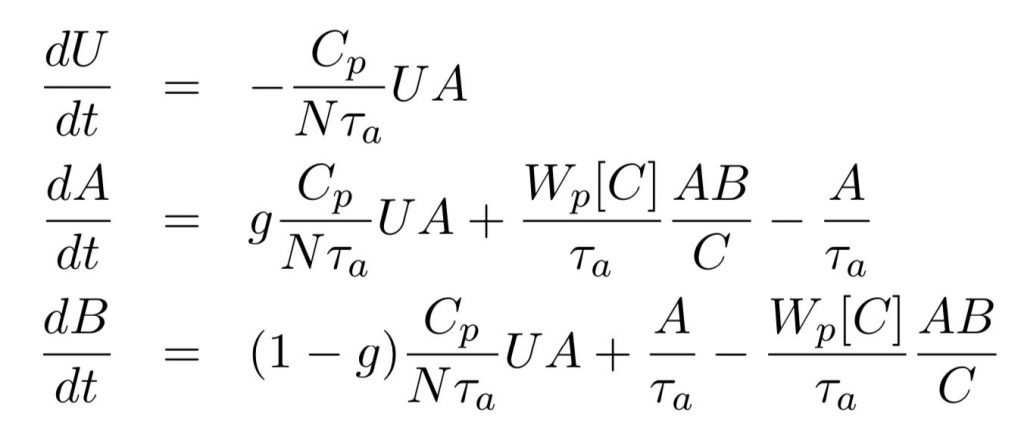
where the potential number of believers renewed is given by:

A represents the number of enthusiasts (active believers). B is the number of inactive believers and U the number of unbelievers. The total church C = A + B. The total population N = A + B + U.
When the church C is small, transmission is governed by “mass action”, where people’s contact networks are small, Wp = Wmax C / C1/2. Thus, for renewal, dA/dt ~ AB.
As the church grows, the transmission becomes standard incidence because the contact network is too large for everyone to be reached, Wp = Wmax. Thus, for renewal, dA/dt ~ AB/C. (See Assumptions for further details).
Enhanced Revival Threshold
Revival growth occurs if the number of enthusiasts increases, that is, dA/dt > 0. From the second equation of equation 1, this condition gives the revival threshold Rrevival:
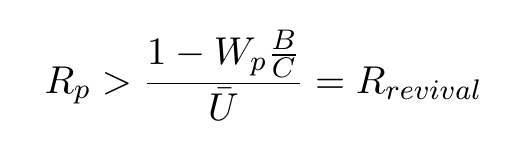
Thus, revival growth occurs if the reproduction, Rp = gCp, is greater than the revival threshold. If the church has renewal, Wp > 0, the revival threshold is lowered, making revival growth more likely.
Results
Let a church have an inadequate reproduction potential, Rp = 0.85. With Rp < 1, enthusiasts cannot reproduce enough enthusiasts from converts to replace themselves. Thus, the church will not experience accelerating growth and will fail to grow. If renewal is introduced, Wmax = 1.2, the church can produce enthusiasts from inactive believers (Figure 1).
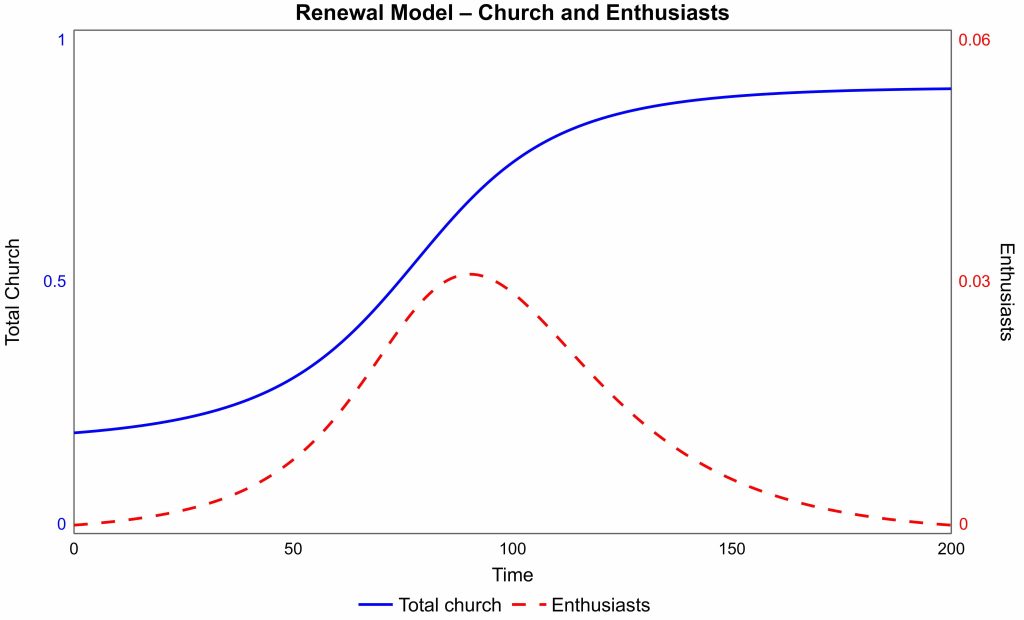
Figure 1 shows the initial rise in the number of enthusiasts, peaking around time = 90. Initial church growth is slow as enthusiasts take time to accumulate. Revival growth occurs when the reproduction potential exceeds the revised revival threshold (equation 3). Figure 2 shows the revival threshold with renewal (red dashed curve) below the reproduction potential (blue line) for the first 100 time units. Indeed, renewal drives the threshold down further, until high conversion raises it again after 80 time units.
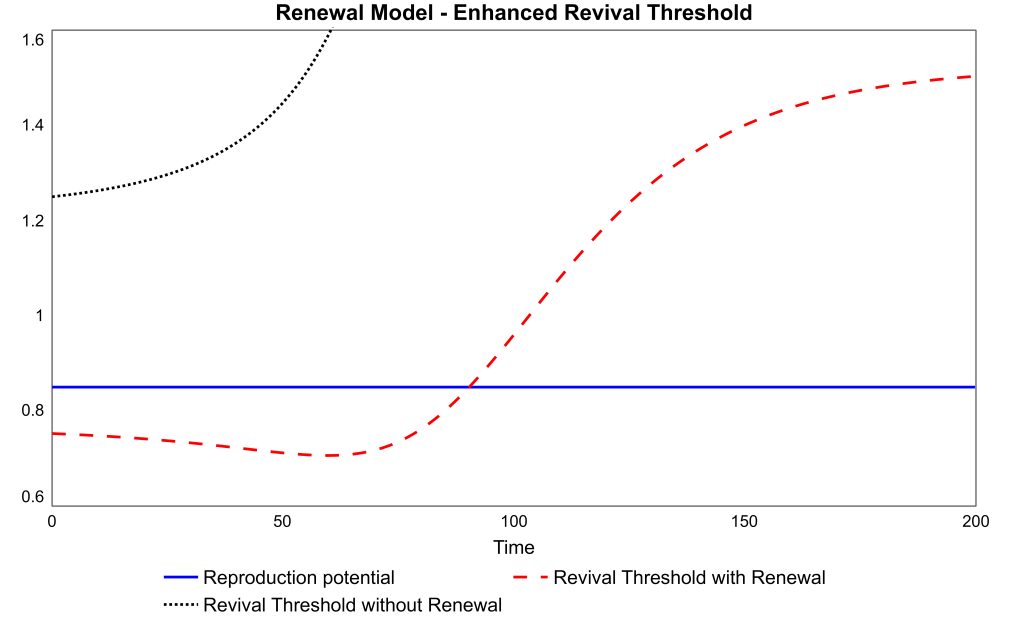
Figure 2 also compares the revival threshold enhanced by renewal (equation 3) with the same threshold without renewal (black dotted line). The presence of renewal can significantly affect this threshold, enabling revival growth.
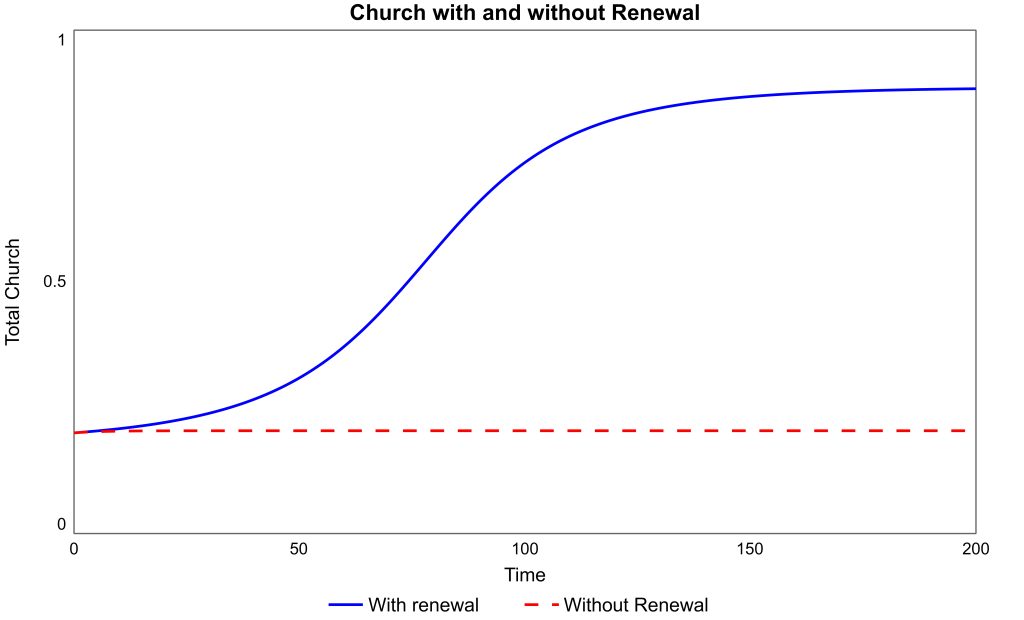
Figure 3 compares church growth with and without renewal. Clearly, renewal can spark revival growth, dramatically impacting church growth. (See also Renewal Model Results).
Conversion and Renewal Rates
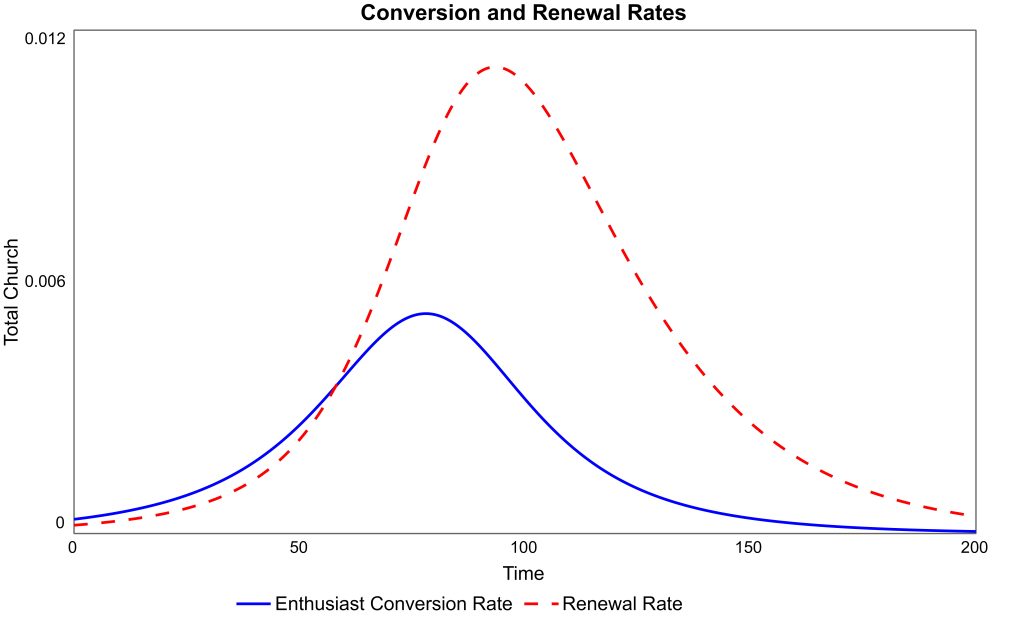
Initially, the renewal rate is low and below the conversion rate. However, as it increases, the exponential reinforcing process can occur among inactive believers. Eventually, more people become enthusiasts through renewal rather than conversion, enabling enthusiast production for much longer than would be possible without renewal. Renewal is the key to evangelism and church growth.
Parameter Values
The parameter values used are given in the table
| Parameter | Values |
|---|---|
| Cp | 1.7 |
| g | 0.5 |
| τa | 2 |
| C1/2 | 0.4 |
| N | 1 |
| C0 | 0.2 |
| A0 | 0.5% |
