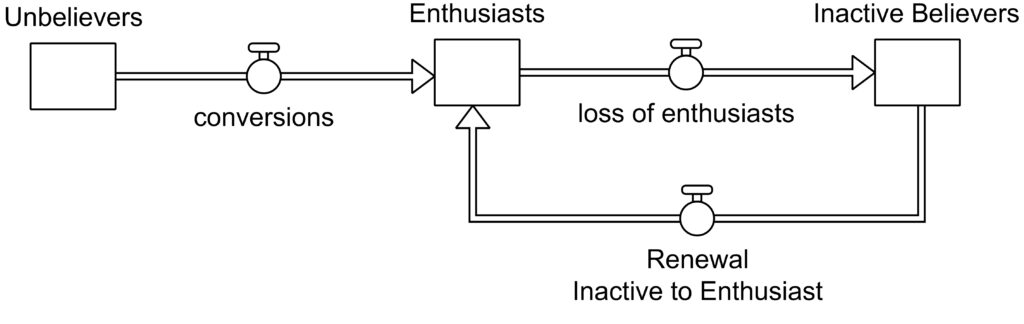
Renewal is an act of the Holy Spirit in which enthusiasts are made from existing believers, as if they had been converted. I described this process in the first Renewal Model of Church Growth. The model has only two categories within the church, so renewal is a flow from inactive believers to enthusiasts (Figure 1). Enthusiasts are believers involved in converting people to the church.
Renewal becomes more complex when there are three categories in the church, as in the Activist Model. Active believers, or activists, are believers who are involved in the life of the church, though not in the conversion or recruitment of unbelievers. There are now three types of renewal, as illustrated in Figure 2:
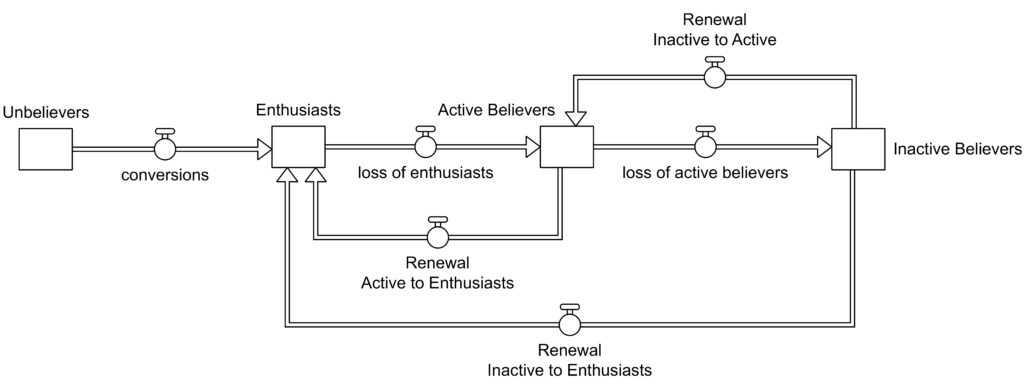
The three types of renewal are:
- Inactive believers become enthusiasts through contact with enthusiasts.
- Inactive believers become non-enthusiastic active believers through contact with activists and enthusiasts.
- Active believers become enthusiasts through contact with enthusiasts.
I call the first two types of renewal Evangelistic Renewal, because they generate enthusiasts and thus directly affect evangelism (1 and 2 above). The third type (3) I call Active Renewal.
Evangelistic Renewal
Evangelistic renewal generates enthusiasts from existing believers. There are two possibilities. Either non-enthusiast active believers become enthusiasts, or inactive believers become enthusiasts. These are different types of people. For example, active believers are involved in the life of the church and regularly mix with enthusiasts. By contrast, inactive believers may attend worship only, and some may not even do that regularly. The inactive will have less contact with enthusiasts and may even be harder to persuade to become enthusiasts. Thus, I have allowed the renewal rates for the inactive and active to differ.
In my experience at church, I can think of many people who became “on fire” for the Lord. Most of these were already active in the church, teaching Sunday school or in a worship band. Nevertheless, I can think of some whose involvement in church was minimal, but after an Alpha course, they became enthusiasts, influencing people outside the church. Hence, I need both types of evangelistic renewal in the model.
Active Renewal
Active renewal generates active believers from inactive ones. Although the presence of more active believers makes no difference to church growth in this model, in reality, more active people create more engaged churches. I describe these effects in other models. For example, active believers help generate spiritual life, making enthusiasts more effective. See the Spiritual Life Model.
Equations
The simplest model has four categories: unbelievers (U), enthusiasts (I), active believers (A) and inactive believers (B). The equations of the model describe the change in these categories:
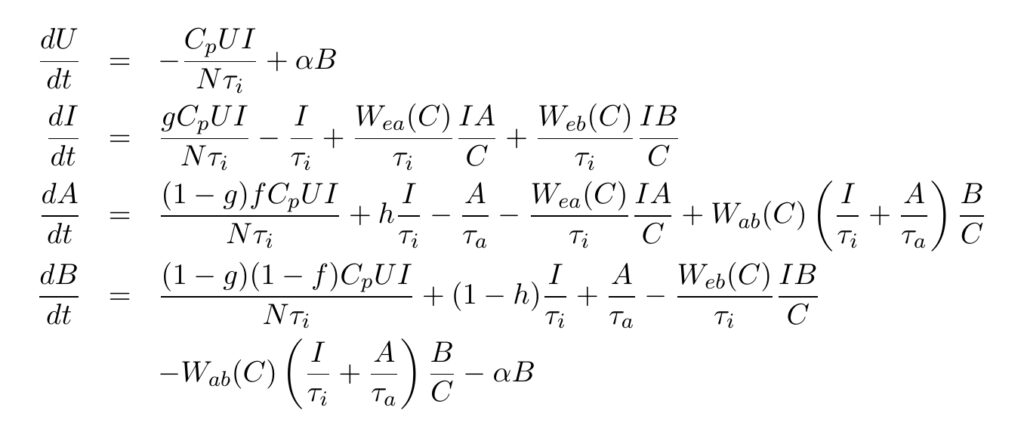
where the three renewal potentials depend on the size of the church and are given by equation 2:
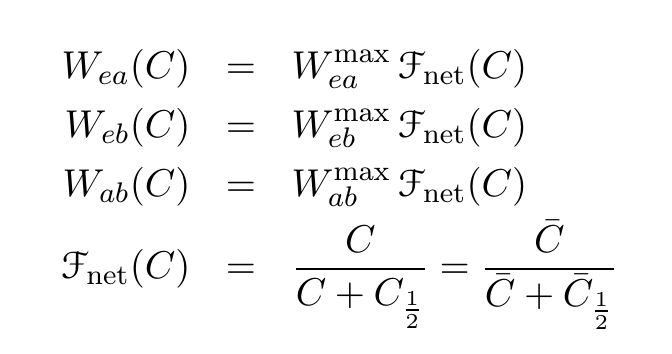
I describe the network effect of the renewal model in the Renewal Model Details section.
Parameters
Most of the parameters are the same as the basic Renewal Model and the Demographic and Activist Models. These are all additions to the Limited Enthusiasm model. The key parameters for conversion and renewal are:
| Parameter | Meaning |
|---|---|
| Reproduction potential – how many new converts become enthusiasts per person. | |
| Evangelistic renewal potential active – how many active believers become enthusiasts, given network saturation | |
| Evangelistic renewal potential inactive – how many inactive believers become enthusiasts, given network saturation | |
| Active renewal potential – how many inactive believers become active believers, given network saturation |
The values of these parameters determine the nature of revival growth in the church.
Threshold
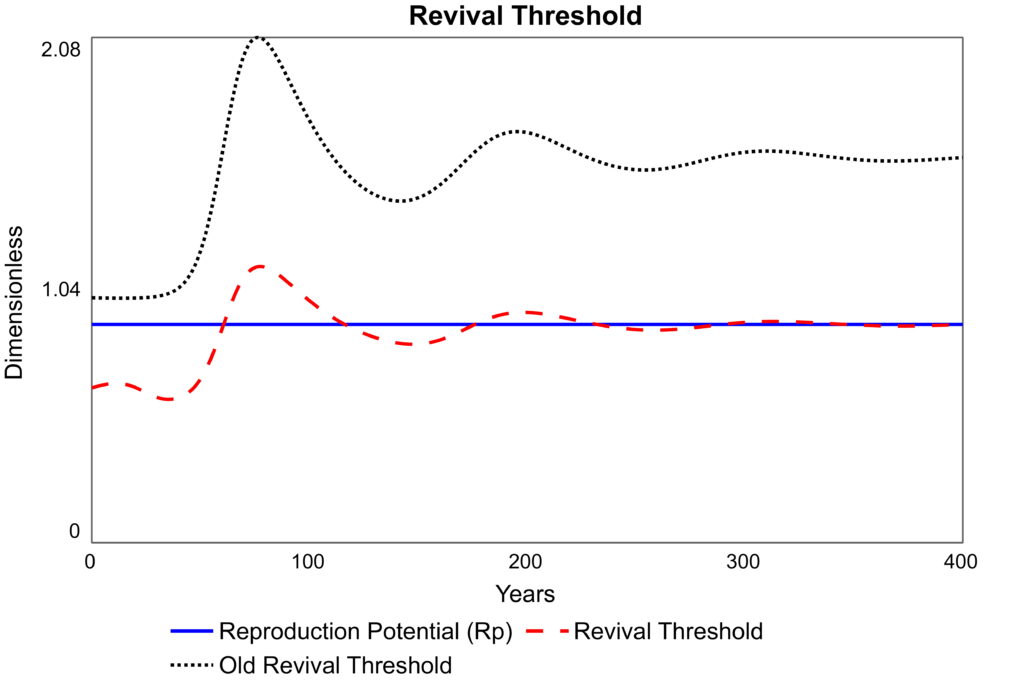
Revival growth occurs if the number of enthusiasts increases, . From the second equation of equation 1, the condition for revival growth becomes:

is called the revival threshold, which decreases during evangelistic renewal. Thus, this type of renewal makes revival growth more likely.
Rapidly Accelerating Growth
To show the effects of renewal, I set the reproduction below the revival threshold based on conversion only, . Without renewal, this church would decline to extinction, regardless of the values of the other parameters. I then introduced all three types of renewal with , and . These numbers represent a church with more evangelistic renewal among active believers than either type of renewal among the inactive. The result is rapidly accelerating growth after 40 years (Figure 3).
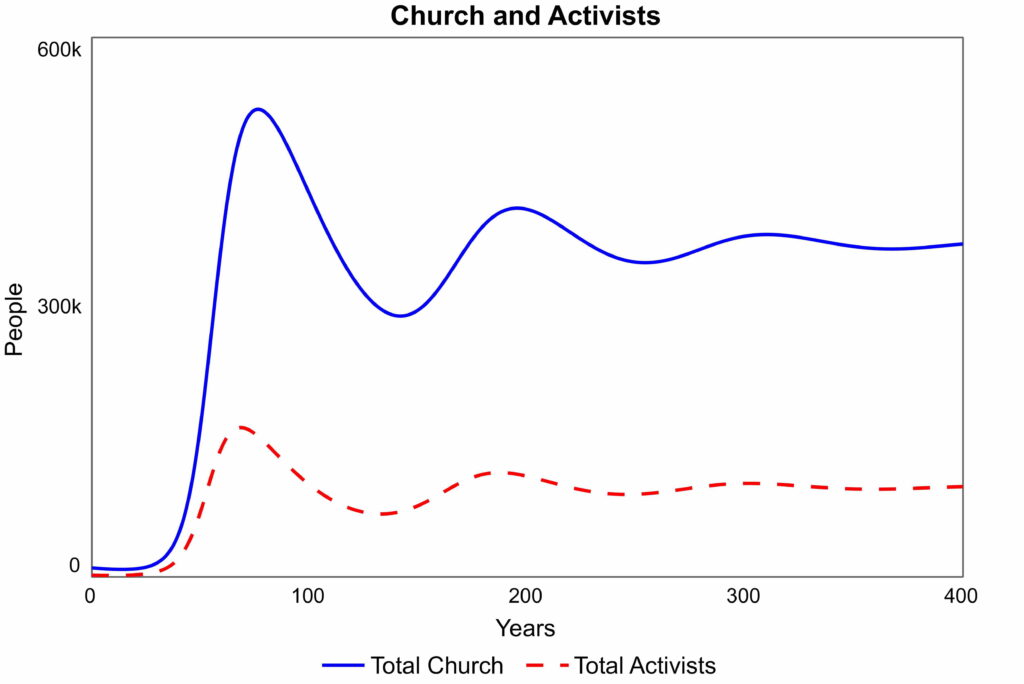
Sharply accelerating growth is typical of revival enhanced by renewal. (See for example Revival by Renewal, Figure 3). The presence of multiple reinforcing loops associated with conversion and renewal is the primary cause of rapid acceleration.
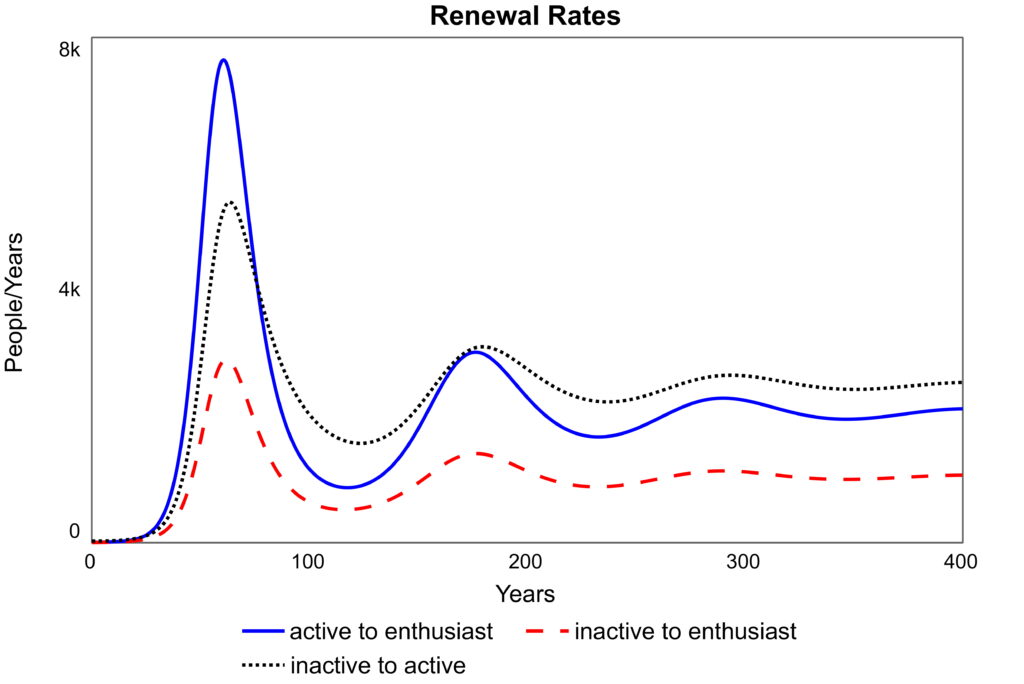
In this model, there are three types of renewal growth, each with reinforcing feedback. Figure 4 shows their relative contribution. Although evangelistic renewal from active believers is the largest in the first phase, active renewal becomes the largest as equilibrium is approached.
Threshold Behaviour
Figure 5 compares the reproduction potential with the revival threshold. Although RpR_p starts below the old revival threshold (the one without renewal), it is above the threshold enhanced by renewal. Once the church grows rapidly, the threshold rises. Once it is above , at about 60 years, church growth slows, and revival growth ends.
In this scenario, the church temporarily exceeds its carrying capacity as people move through activity and inactivity with the church and new generations emerge replacing those who die (Figure 3). If reversion and sociological effects are present, this overshoot of equilibrium may be much smaller, with oscillations dying out faster. Nevertheless, revival growth is enhanced by both types of evangelistic renewal. Active renewal, when accompanied by spiritual life, will create slower and more sustainable growth.
