The central hypothesis of the limited enthusiasm model is that conversion growth in the church is driven by a sub-group of church members called enthusiasts. The enthusiasts have limited potential to convert, as they cease to be enthusiasts after a set period. As such, church growth is limited as enthusiasts fail to reproduce themselves from a shrinking pool of potential converts.
The following model details supplement the Limited Enthusiasm Model Overview.
- Assumptions
- System Dynamics Model
- Dynamic Hypotheses
- Equations
- What is Meant by “Spreading the Faith”?
- How is the Faith Spread?
- Why Do Enthusiasts Stop Spreading the Faith?
- Why Do Some New Converts Never Spread the Faith?
- Why Do Enthusiasts Spread the Faith Less as Church Grows?
- Model Parameters
- Results
Assumptions
The model consists of three groups of people: unbelievers, enthusiasts (or active believers) who alone are responsible for spreading the faith, and inactive believers. For simplicity, all church members are assumed to be believers and vice versa. This is because there is no data on who among a church membership are true believers in Jesus Christ. It is difficult to see how this type of data could be reliably determined. It is further assumed that members are identical to the church’s attenders. This is because there is only reliable attendance data. Membership data is less reliable because different denominations and churches use varying definitions of membership. Thus, the model addresses only attendance and recruitment issues. Sometimes membership data must be used when no attendance data is available.
In reality, there will be members and attendees who are not believers, members who do not attend and attendees who are not members. There may even be believers who are neither members nor attendees. However, these effects tend to cancel out, and the above assumptions imply that their net effect is negligible.
System Dynamics Model
The dynamic hypotheses translate into the system dynamics model using three stocks and three feedback loops:

Dynamics Hypotheses
The dynamic hypotheses are:
| DYNAMIC HYPOTHESIS | DESCRIPTION |
|---|---|
| Conversion Through Enthusiasts (R) | Enthusiasts are responsible for spreading the faith, i.e. conversion to the church. The more they convert the more enthusiasts. This accelerates growth. Spreading the faith can be by numerous means. |
| Loss of Enthusiasm (B2) | After a period of time, enthusiasts lose their potential to convert. This slows and limits growth. |
| Diminishing Susceptible Pool (B1) | As people are converted the effectiveness of the enthusiasts on the remaining unbelievers become less as proportionally more of the enthusiast’s time is spent on believers. This slows growth. |
| Not All Converts Become Enthusiasts | Not every convert becomes an enthusiast. Some become immediately inactive. |
Equations
The differential equations of the model are:
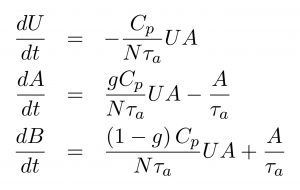
where U, A and B are unbelievers, enthusiasts and inactive believers, respectively. N is the total population. Cp is the conversion potential. g is the fraction of converts who become enthusiasts. Thus, Rp = g Cp is the reproduction potential. τa is the duration enthusiasts are active. See the parameters below.
What is Meant by “Spreading the Faith”?
Spreading the faith means an unbeliever becoming a believer, a process called conversion. It is measured by a new convert becoming an attender at church or a member of a church. In this model, conversion is the only method of recruitment. Other mechanisms, such as transfers from different churches or children born into the church, are excluded.
Such conversion is usually accompanied by other observable changes in the convert, such as enthusiasm for the Christian faith, adoption of a new moral code and resulting behavioural changes. Thus a believer is assumed to be easily distinguished from an unbeliever.
How is the Faith Spread?
In this model, it is assumed the faith is spread by word-of-mouth contact alone. An enthusiast contacts an unbeliever through a network of friends, relatives, work colleagues and acquaintances. The enthusiast may be the person who “leads the unbeliever to Christ” by saying a prayer of commitment in some evangelistic methods. It may be the person who explains the gospel to them. However, it is more likely that the key contact is the person who invites the convert to a meeting or church where the conversion occurs sometime later at the hands of others.
The enthusiast is not necessarily a theological expert or an evangelist, but a believer with enough enthusiasm to use their network of contacts to foster a positive attitude toward Christ, Christian things, or the church. Something about them makes Christ attractive – attractive enough that the unbeliever may read something they would never have read otherwise. Or, they go to a church meeting they would never have considered.
Why Enthusiasts Stop Spreading the Faith?
- The enthusiasts have been recruiting through their network of friends and relatives, but that pool is now exhausted. There are three scenarios:
- The people in this network have become believers themselves;
- People in this network have become immune to any further pressure to join the church;
- The enthusiasts have ceased to have meaningful contact with unbelievers. Many new converts find that after a year or so they have a new set of friends in the church, and their old unbelieving friends have drifted away. Often, the new convert does this subconsciously because being part of the church means adopting a new set of values, which leaves them uncomfortable with those of their old friends. In strict churches, they may even be encouraged to distance themselves from the world, inadvertently losing their recruitment potential.
- Churches do not just recruit or evangelise. After a while, new converts find other work to do within the church and spend less time on recruitment activities.
- In periods of intense growth, the pastoral demands of dealing with new converts prevent ministers from spending as much time on evangelism as they might like and thus their recruitment potential drops.
- Often, believers run out of enthusiasm for recruitment and settle into a more subdued form of belief, with zeal to see new converts declining to the point of inactivity. Again, there are several scenarios behind this:
- The believer has forgotten why they converted from unbelief to belief. They now have no desire to see others converted;
- Often, believers gain status within the church and lose sight of the real reasons they joined in the first place. Any enthusiasm they now have is centred on their own advancement within the church;
- In non-strict churches, the members’ lifestyles are so close to the world that the new convert quickly sees little point in attempting to win people to the church. Believers are so similar to unbelievers that they have little to offer and so stop seeking converts;
- The believers may find the church so enjoyable that their enthusiasm is for their own experience of it, or of God, rather than to see others converted;
- Perhaps the church has not lived up to expectations, and the believer has lost enthusiasm for anything related to those beliefs. Instead, they have settled into nominal church life.
Many of these reasons are summed up in Wesley’s Law of the decay of pure religion. “Taking up the religion has produced benefits which make missionary zeal too costly to engage in.” (Kelley) (See Wesley’s Law). Thus, the assumption is that a believer’s enthusiasm for recruiting lasts only a limited time after their conversion.
Why Do Some New Converts Never Spread the Faith?
- Converts may be naturally shy and unwilling to engage in any form of recruitment;
- They may be a social isolate and have virtually no network of friends to influence;
- They may be a secondary convert, the spouse or child of a primary convert, who has”converted” for social reasons. Often, such secondary converts have little real enthusiasm for the actual faith;
- People can be converted to the ethos of the church – its services, customs, and morality – without ever being converted to the truth of the faith. As such, they may have little desire to see others converted. Their “conversion” has been a purely social phenomenon rather than one of deep religious convictions. Nevertheless, they are part of the church, albeit an inactive believer.
Why Do Enthusiasts Spread the Faith Less as Church Grows?
As new converts are made, the church grows, and the unbelieving community gets proportionally less. This effect follows from the assumption of homogeneous mixing, meaning that an enthusiast is equally likely to have contact with an unbeliever or a believer. Thus, the likelihood of such contact decreases as people are converted. If the majority of contacts come from intentional evangelism, then this assumption will be invalid. However, even with such evangelism, most contacts come through word of mouth in day-to-day life. Since churches are generally not ghettos and believers are equally represented in all areas of life, homogeneous mixing is usually valid.
Model Parameters
The behaviour of the model is controlled by a number of parameters that reflect the church’s effectiveness and the response of society:
| PARAMETER | DESCRIPTION |
|---|---|
| Reproduction Potential Rp | This is the number of unbelievers converted and made enthusiasts, through one existing enthusiast, given the whole population are unbelievers. It measures how much an enthusiast can “reproduce” themselves from the pool of unbelievers. |
| Duration of Enthusiastic Phase τa | The average length of time an enthusiast is active in conversion before they become an inactive believer. |
| Fraction of Converts Enthusiast g | The fraction of new converts who become enthusiasts. The remaining converts become inactive believers immediately on conversion. |
| Initial Fraction of Church Enthusiast | The fraction of the church who are enthusiasts at the start of the model. |