Results of the Spiritual Life Through Activists Model
As the number of active believers in the church grows, so does the church’s spiritual life. This, in turn, empowers the enthusiasts to be more effective, leading to increased church growth and more activists.
- Spiritual life accelerates growth
- Church impurity and decline
- Spiritual burnout
- Overshoot and decline
Spiritual Life Accelerates Growth
A church starts with a low spiritual life, Figure 1. Active believers rapidly increase the life of the church, as shown by the red dashed curve. The church does not grow immediately. When sufficient spiritual life is built, the church rises rapidly, as shown by the blue curve in Figure 1. Grow is accelerated by two feedback loops. Firstly, more enthusiasts lead to more converts, which in turn lead to even more enthusiasts. Secondly, more active believers give more life and, thus, even more activists.

The rise in spiritual life increases the reproduction potential of enthusiasts (Figure 2, blue curve). The primary reason revival growth ends is the rise in the revival threshold (Figure 2, red dashed curve). This follows because the shrinking pool of unbelievers makes it impossible for enthusiasts to produce enough converts to reproduce themselves. Enthusiasts could only continue reproducing if spiritual life kept increasing; instead, both life and the reproduction potential have levelled out.

Church Impurity and Decline
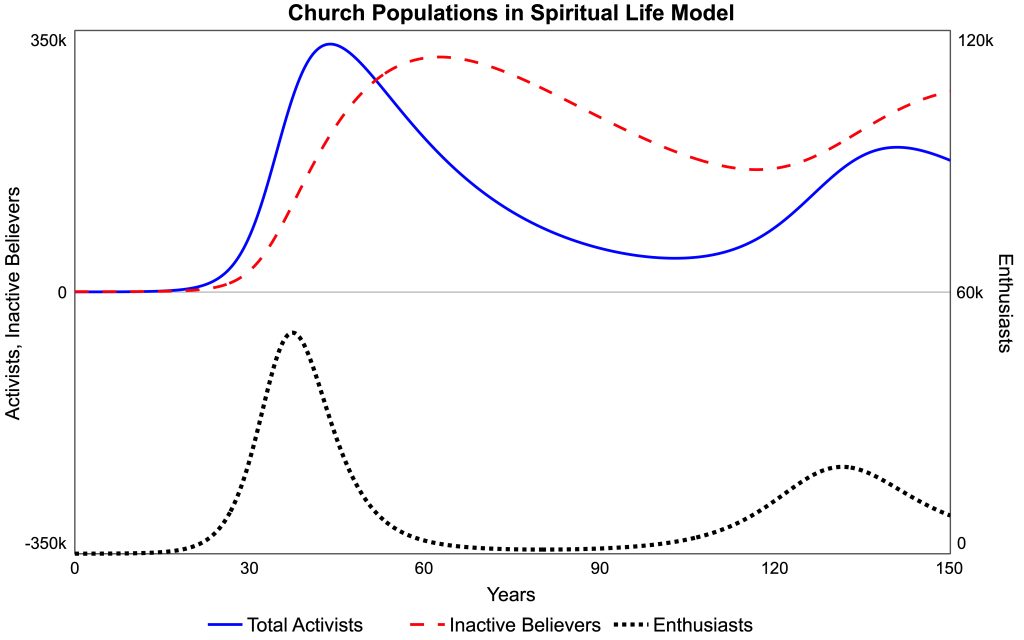
Spiritual life stops increasing (Figure 1, red dashed curve) because the balance of believers shifts from activists to inactive believers, Figure 3, top. Activists increase at first, but as some become inactive, the inactive believers come to dominate the church from about the year 60. Thus, enthusiasts cannot improve their reproduction potential, so their numbers plummet, as shown in Figure 3, bottom. A long period of 60 years follows, during which there are few enthusiasts.
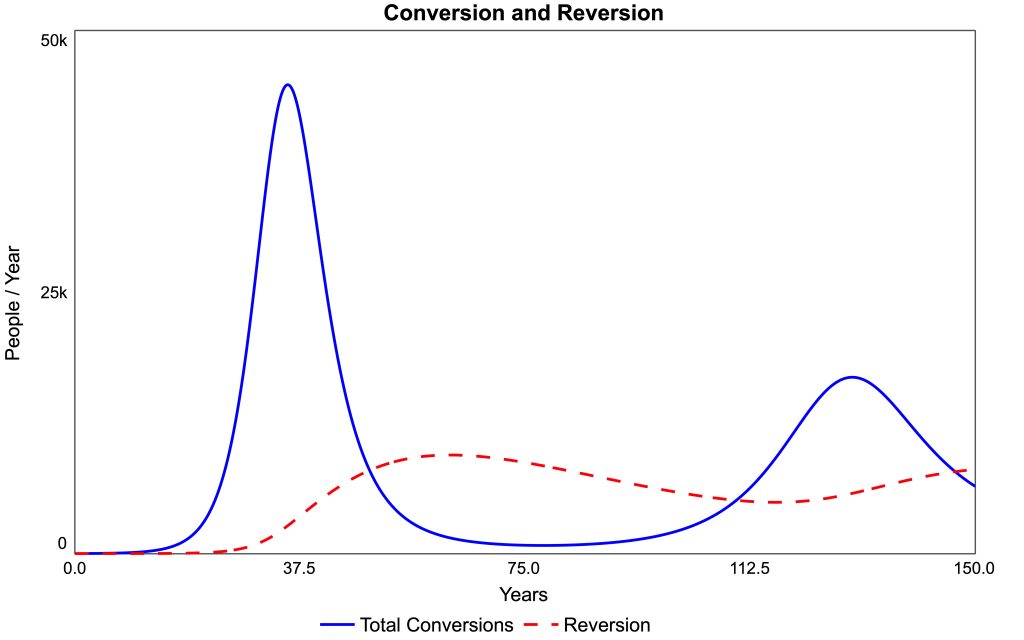
With few enthusiasts, conversions virtually stop and are overtaken by reversion (Figure 4). Church impurity is a major contributor to spiritual and numerical decline.
Spiritual Burnout
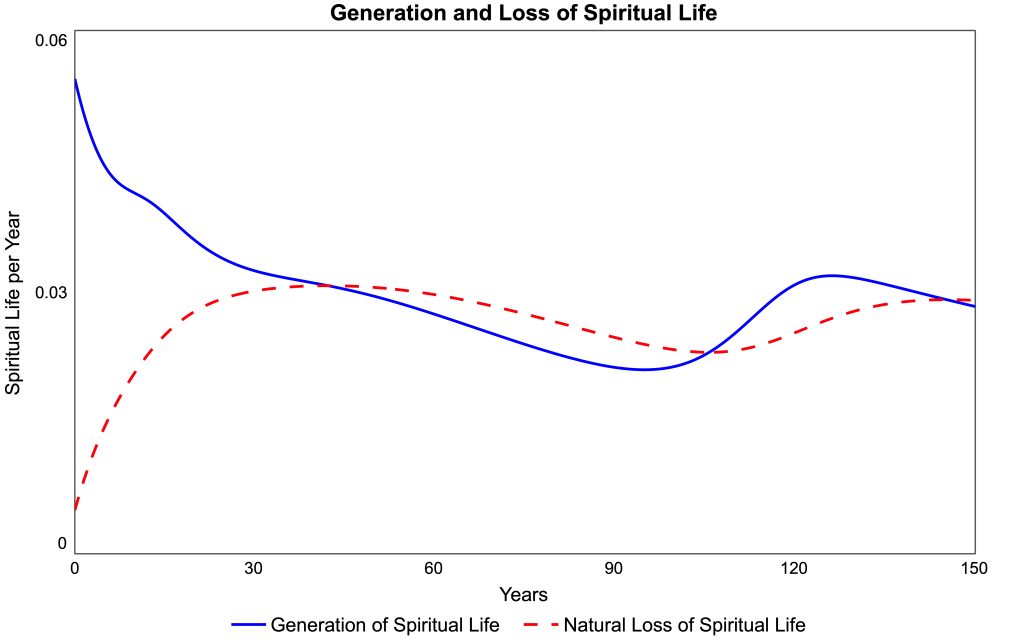
This particular scenario starts with a sharp rise in spiritual life. This rise results from a very high generation in spiritual life by the active believers, Figure 5, blue curve. However, this level of generation cannot be maintained, and the loss of spiritual life eventually catches up. The church has started with very effective activists who suffer from spiritual burnout. Consequently, they cannot reproduce themselves through the spiritual life in the church.
A church could maintain its spiritual life for longer if it did not allow church life to be dominated by inactive believers. The latter has a negative effect on the generation of spiritual life. It is possible that church growth would be higher if inactive believers left the church or were not allowed to influence the church’s life. Alternatively, and more positively, the church could encourage renewal within itself and see inactive believers become active, perhaps even become enthusiasts.
Overshoot and Decline
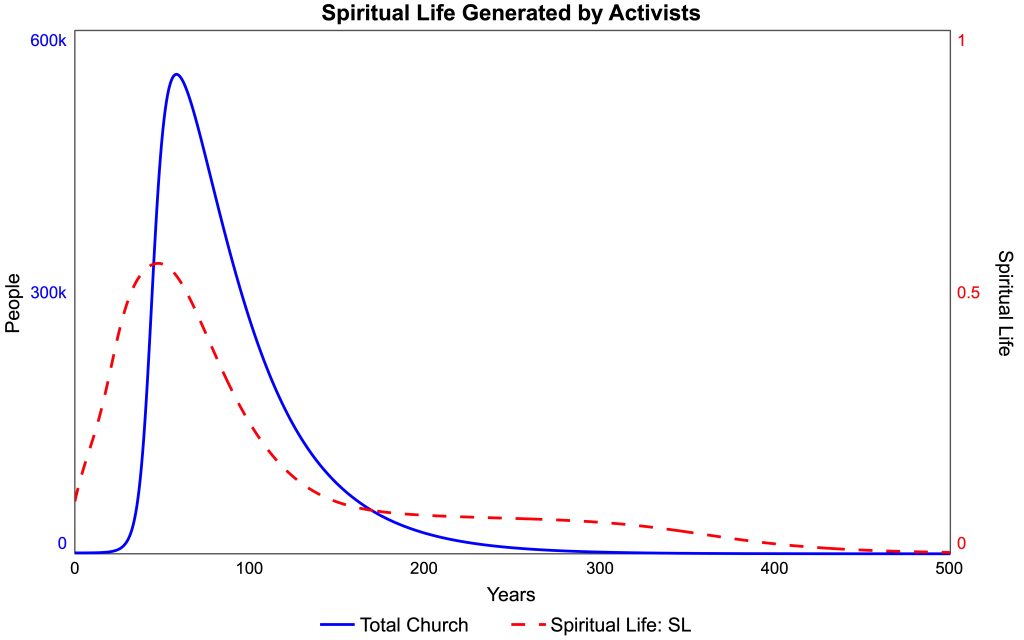
In the above scenario, the church will eventually reach a stable equilibrium. The active believers have produced enough life for the church to thrive. However, if those activists are less effective at fostering spiritual life, the church will continue to decline after its initial growth and become extinct (Figure 6). In comparison with Figure 1, the activists cannot maintain their spiritual lives after the revival. These activists produce less than half as much spiritual life as in Figure 1. Once inactive believers dominate the church, the activists are unable to keep the church spiritually alive. Revival is no guarantee that extinction will not occur in the future. A church needs to keep seeking the work of the Holy Spirit.
The church’s initial revival growth follows from the reproduction potential exceeding the revival threshold up to about 80 years (Figure 7). The revival threshold rises rapidly as the number of unbelievers shrinks, and after 80 years, the accelerating growth ends. Unlike in the previous scenario in Figure 2, the revival threshold never falls below the reproduction potential. In the last scenario, the activists were effective at fostering spiritual life, and the reproduction potential was maintained (Figure 2). In the new scenario, the activists are less effective, and the reproduction potential is falling rapidly. Eventually, it falls below the extinction threshold around year 150, and the church declines to zero (Figure 6).
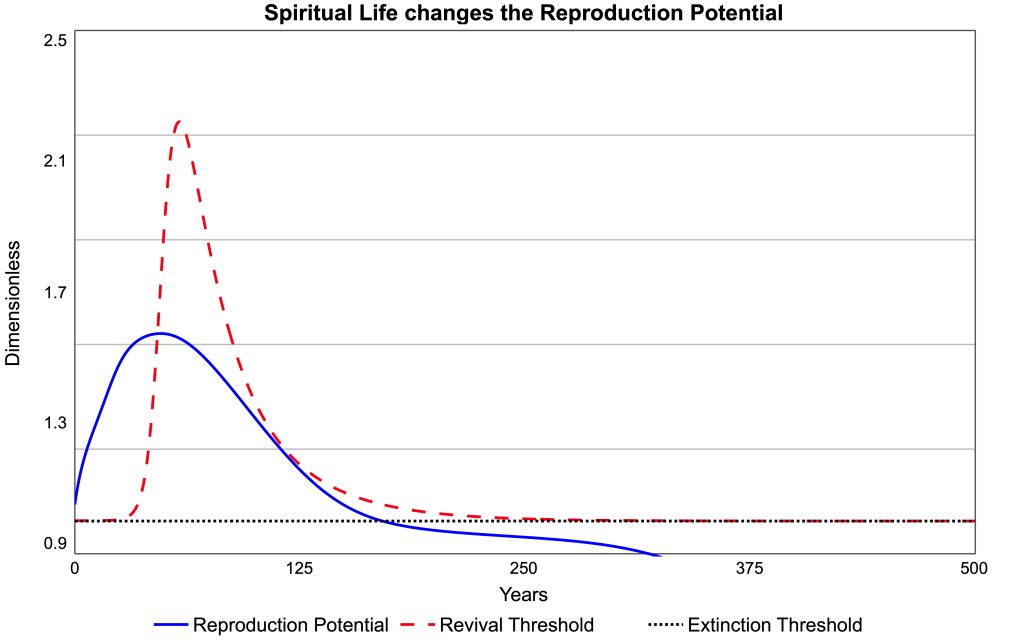
One possible explanation for the current decline in church attendance in the UK and the USA is that denominations built up in revival times have failed to maintain their earlier spiritual life. Consequently, the reproduction potential has fallen as fast as the revival threshold (Figure 7) and has now fallen below the extinction threshold.
Further Results of the Spiritual Life Model
- Spiritual Life and Sustainability. The sustainability of spiritual life is only possible if there are new converts from an expanding pool of unbelievers or through spiritual renewal.
- Modelling the Effects of the Baptism with the Holy Spirit. When the Lord Jesus baptises his church with the Holy Spirit, there is a sudden increase in life and growth in the church.