Background
The Limited Enthusiasm Model with Activists has three types of church members:
- Active Believers. Believers who are active in church life – the Activists
- Enthusiasts. Active believers who are also involved in conversion. The power of church growth comes from the enthusiasts’ ability to replicate themselves, thereby creating more enthusiasts.
- Inactive believers. Believers who are not active in the church.
Renewal is the process by which existing believers are either made enthusiasts or active believers. As such, there are three types of renewal:
- Inactive believers become enthusiasts through contact with enthusiasts.
- Active believers become enthusiasts through contact with enthusiasts.
- Inactive believers become non-enthusiastic active believers through contact with activists and enthusiasts.
I have called 1-2 Evangelistic Renewal. and called 3 is Active Renewal. The page “Evangelistic and Active Renewal” describes the model in more detail. Evangelistic renewal can come either from active believers (Evangelistic A) or from unbelievers (Evangelistic B).
Relative Effects of Renewal
I will compare the three types of renewal on church growth. In each case, I set the renewal potential at 2. The base case is a church that grows over a 100-year period without renewal (blue curve, Figure 1). Introducing evangelistic renewal from active believers to enthusiasts yields much greater revival growth (red dashed curve). However, after 100 years, the church numbers are falling to the level they would have been without renewal.
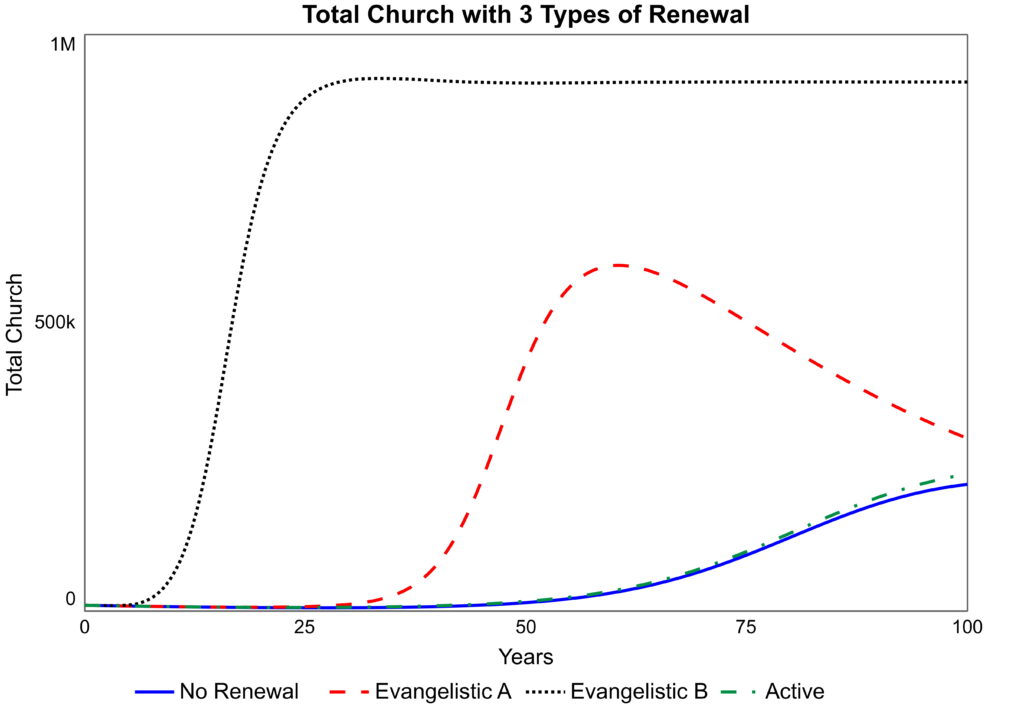
By contrast, evangelistic renewal from unbelievers to enthusiasts gives even higher church growth (black dotted curve, Figure 1). Growth comes in earlier and, most importantly, is sustainable with church numbers remaining high. Both renewals steepen the rise in enthusiasts (compare the dashed and dotted lines with the no-renewal case, the solid blue line, in Figure 2). On its own, evangelistic renewal from activists is less sustainable. However, it is probably easier to achieve than renewal among inactive believers.
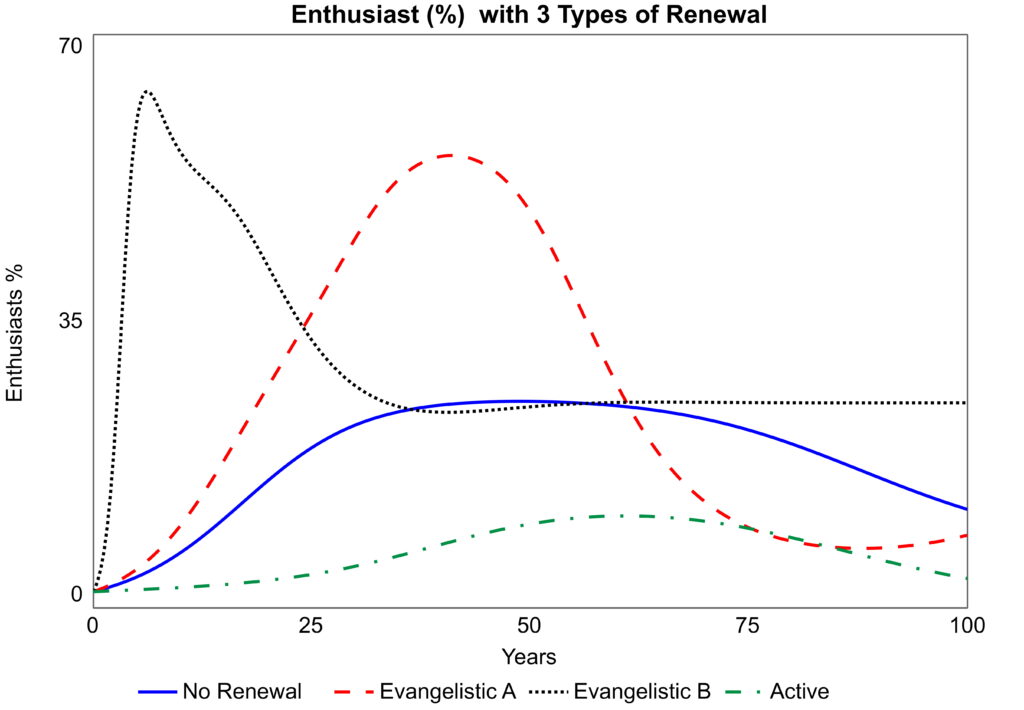
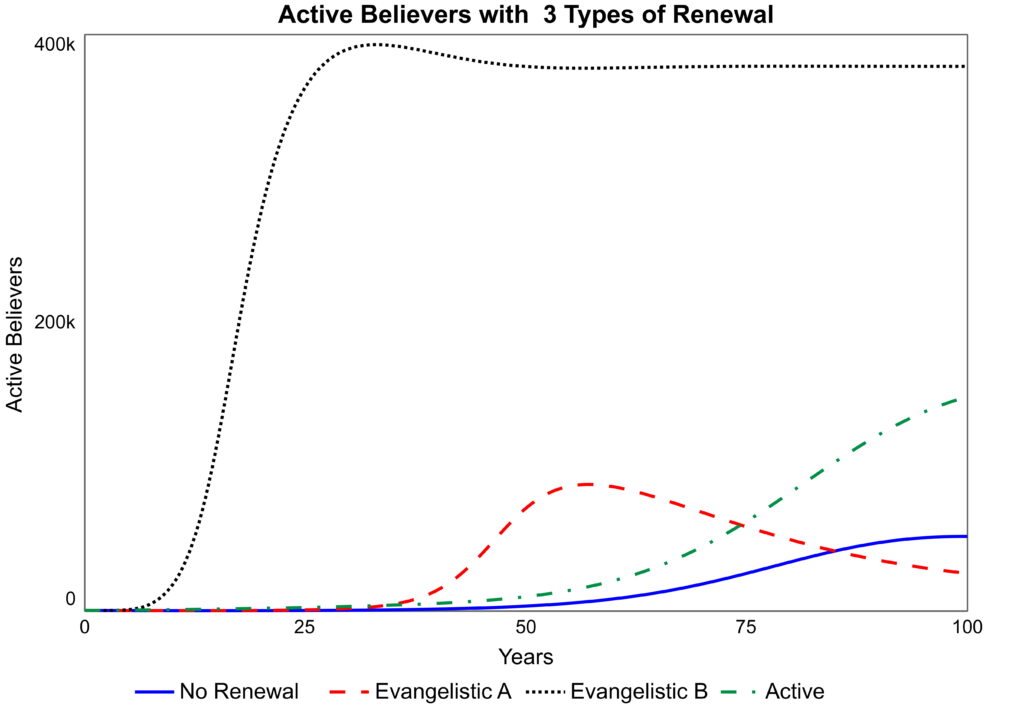
Active renewal has no effect on church growth (green curve, Figure 1), because this mechanism increases only activists (green curve, Figure 3) and leaves enthusiasts unchanged. In this simplified model, active renewal depletes the number of enthusiasts (Figure 2). This depletion occurs because renewal reduces the number of people leaving the church, thereby reducing the pool of potential converts. Church numbers remain the same because, although conversions have dropped, so have reversions.
Active Renewal Avoiding Extinction
Here, I will show a scenario in which active renewal helps a church avoid extinction, even though it does not directly generate any enthusiasts. Let the reproduction be low, 0.475, well below 1, the threshold of extinction in this model. The blue curve in Figure 4 shows the church decline to extinction. This is the base run. Next, I add a moderate amount of evangelistic renewal from active to enthusiasts. The church declines more slowly, but even with renewal, too few enthusiasts are generated, and the church still goes extinct (Figure 4, red dashed curve).
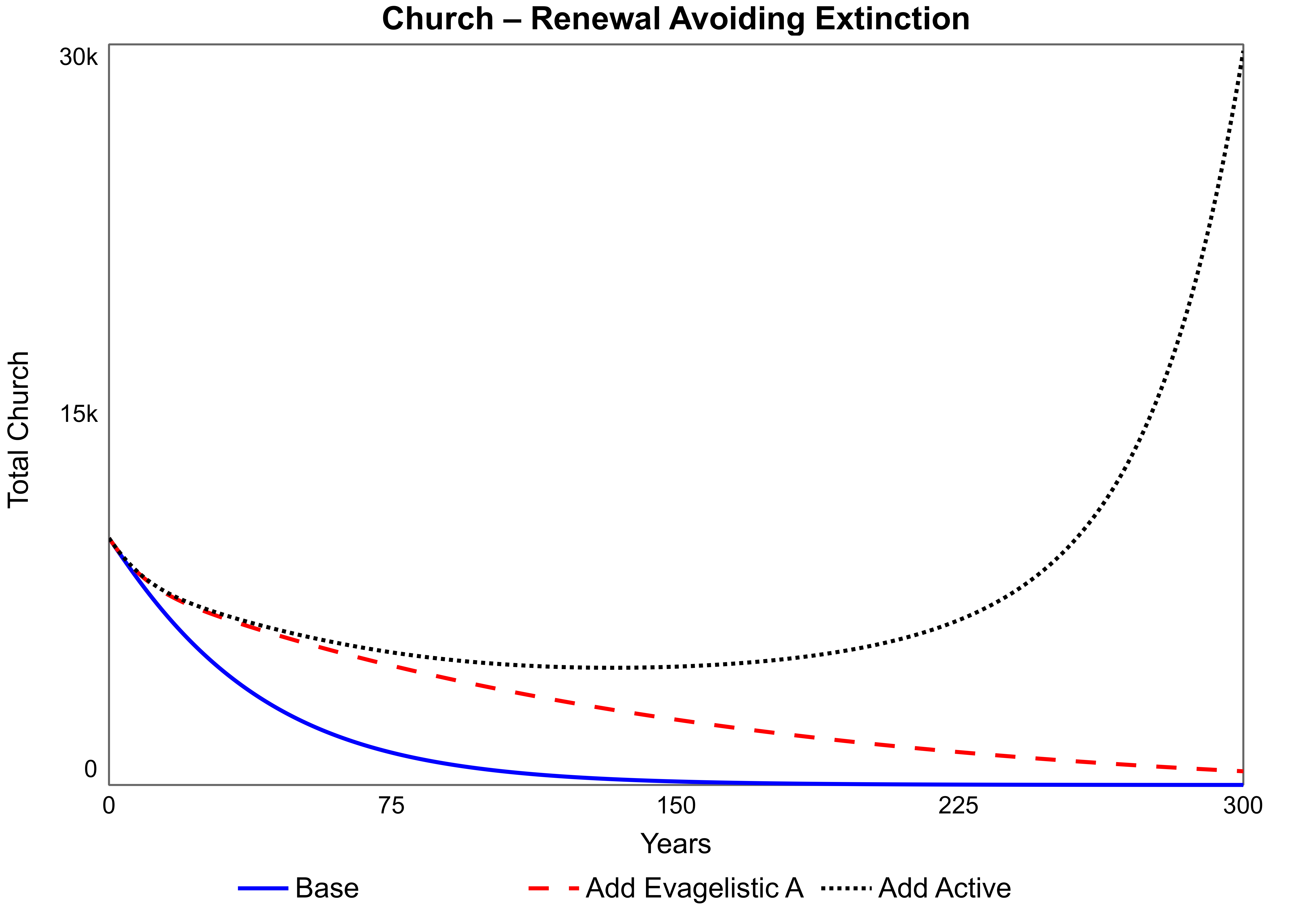
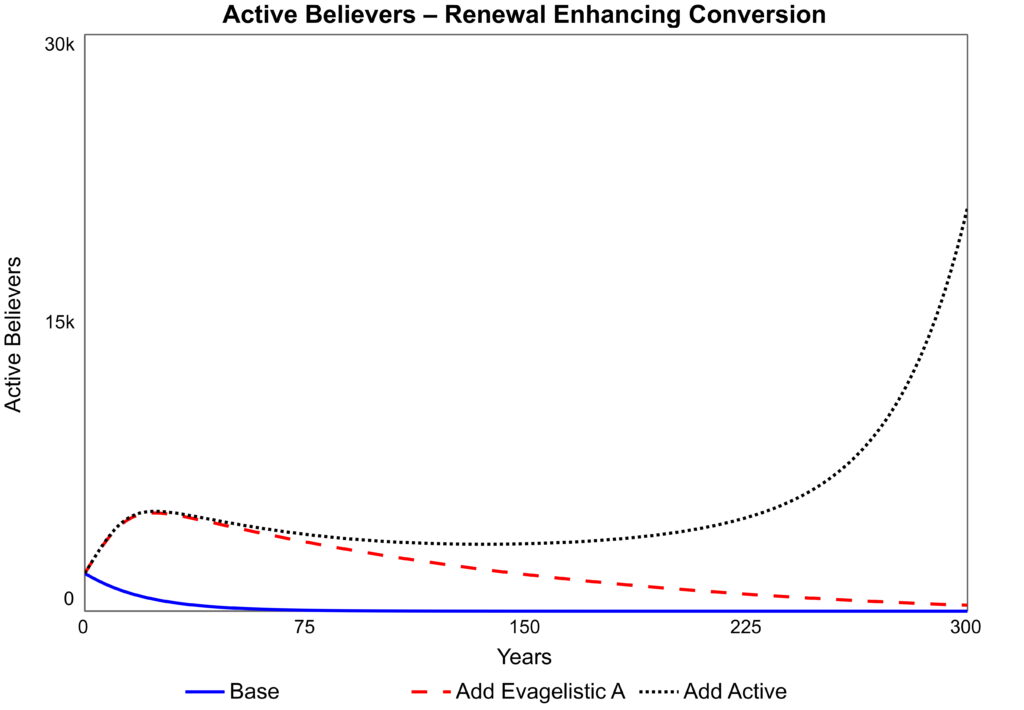
If I now add active renewal, the number of active believers is replenished as inactive believers renew Figure 5, black dotted curve. This renewal now makes the evangelistic renewal more effective. The pool of activists is larger. The result is that the church avoids extinction and enters a state of revival growth (Figure 4, black dotted curve). Thus, active renewal in conjunction with evangelistic renewal can help a church avoid extinction.
Active Renewal Enhancing Revival
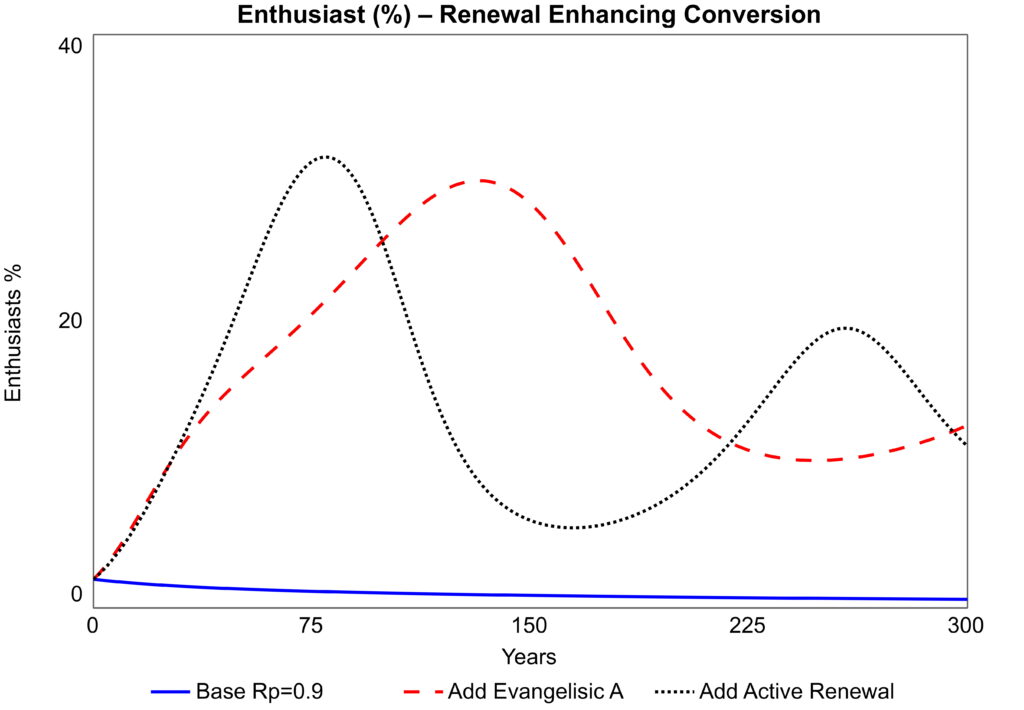
Next, I compare the effects of evangelistic and active renewal on a church whose reproduction potential is just below the threshold of extinction. Let Rp = 0.9. The church heads toward extinction (Figure 7, blue curve). Adding evangelistic renewal from active believers helps the church to start growing after about 50 years (red-dashed curve). Adding active renewal dramatically increases church growth (black-dotted curve). The revival growth comes earlier, peaks higher, and is more sustainable. Active renewal enhances the pool of activists, making evangelistic renewal more effective
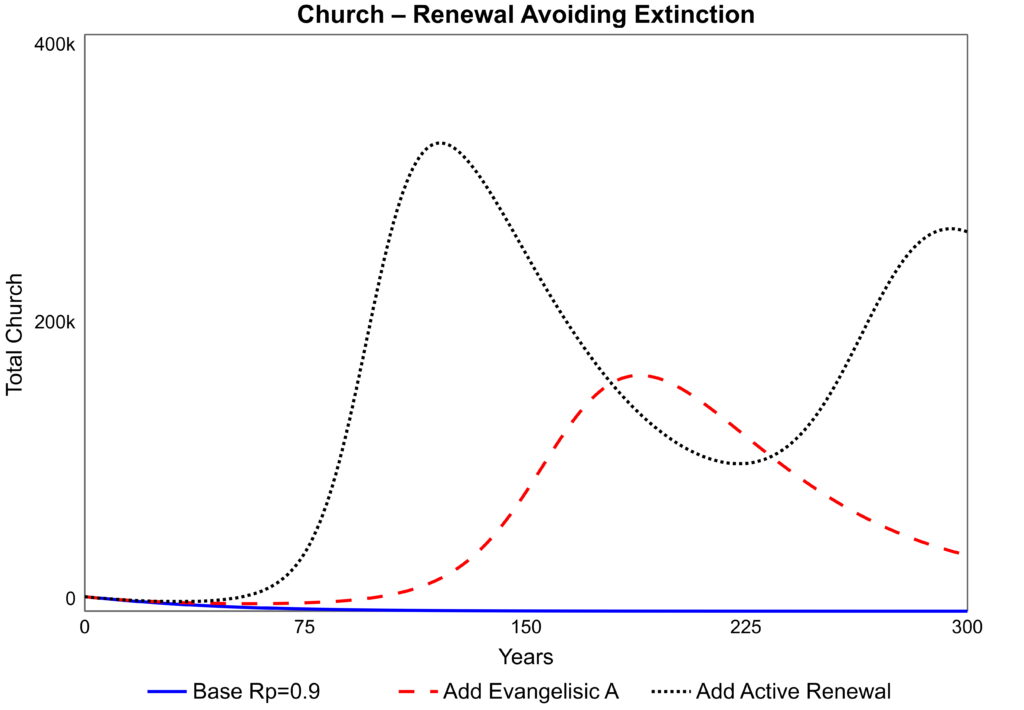
Figure 7 shows the effects of the two types of renewal on enthusiast production. Evangelistic renewal enables enthusiast production to increase (red-dashed curve). Later, around year 30, enthusiast growth slows. When active renewal is added, the slowdown at year 30 is avoided. Enthusiast growth continues to accelerate as active renewal expands the pool of activists – the potential enthusiasts. In this scenario, many inactive believers who are reactivated through renewal later become enthusiasts. Together, both forms of renewal have a powerful effect on church growth.