There is much talk about revival in the Christian Church in the UK at present. Fuel for this discussion was provided earlier in the year by a Bible Society report on the Quiet Revival[1]. Some people have welcomed the report, rejoicing that the Lord is moving in his church again. Others point out that church statistics still indicate decline, not the sort of increases suggested by the Bible Society. I have already written about some of these issues and referenced various discussions[2,3].
A while back, someone said to me, “If there is a Quiet Revival, where is it?” That is the sort of challenge I like!
Quiet Revival Found
When seeking revival, we need to remind ourselves what revival is. It is not an increase in church numbers. That is often a consequence of revival, but it is not revival itself[4]. The word revival is not in the Bible. It is a popular word for what the Bible calls an “Outpouring of the Holy Spirit”. In a previous post, I indicated various ways to measure such an outpouring [3]. One was by direct experience!

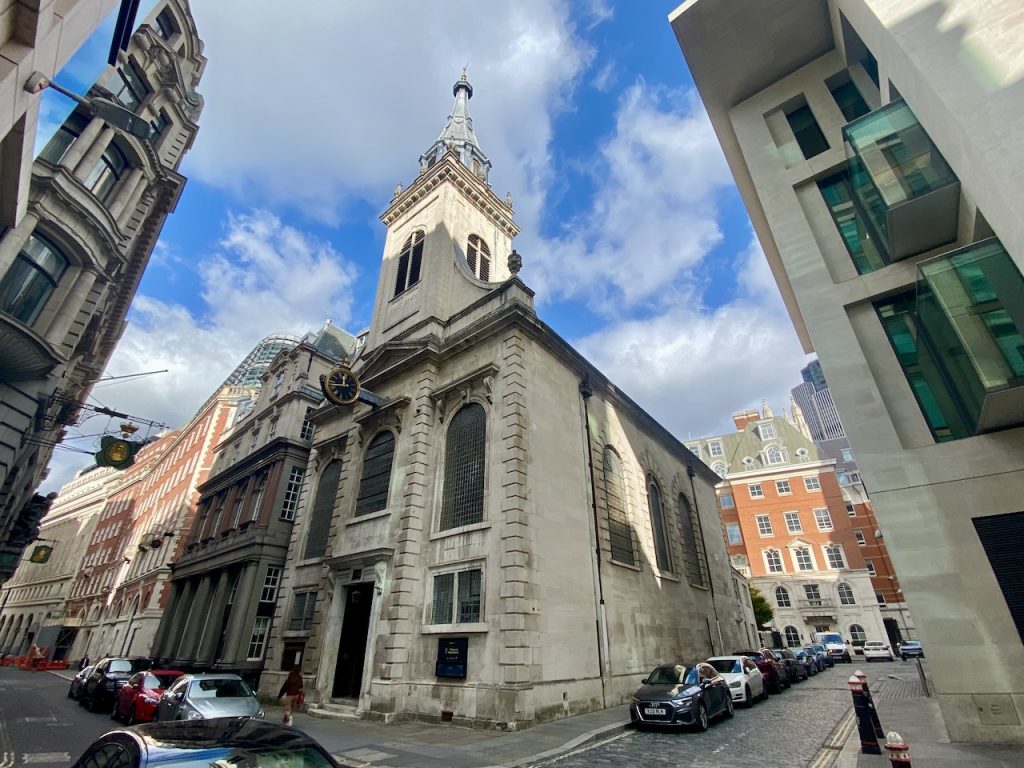
I had my opportunity for that experience when I heard an online talk by a pastor of a growing London church, one largely composed of young people. That was a great excuse for a long weekend in London and to go there myself. The church was called “Imprint”, and it is part of the Church of England meeting at St Mary’s Woolnorth and St Edmund, King and Martyr, both buildings on Lombard Street in the city[5]. St Mary’s is famous as the London church of minister and hymnwriter John Newton. The church has named its coffee shop after him!
The London Imprint church was planted from the original one in Leicester. They are part of the New Wine network that works within the Church of England to equip churches with leaders and the Holy Spirit[6]. They moved into the two historic London church buildings in 2019 and have grown since. Lombard Street hosts four services, and the church has recently planted a new congregation in Croydon. Some staff members are at various stages of ordination within the Church of England.
St Edmund, King and Martyr
At the beginning of October, my wife and I headed for the 12 pm service at St Edmund, King and Martyr. The current building dates to the 1660s, replacing the original that was destroyed in the Great Fire of London. A “Wren” designed church is an interesting venue for a move of the Holy Spirit!
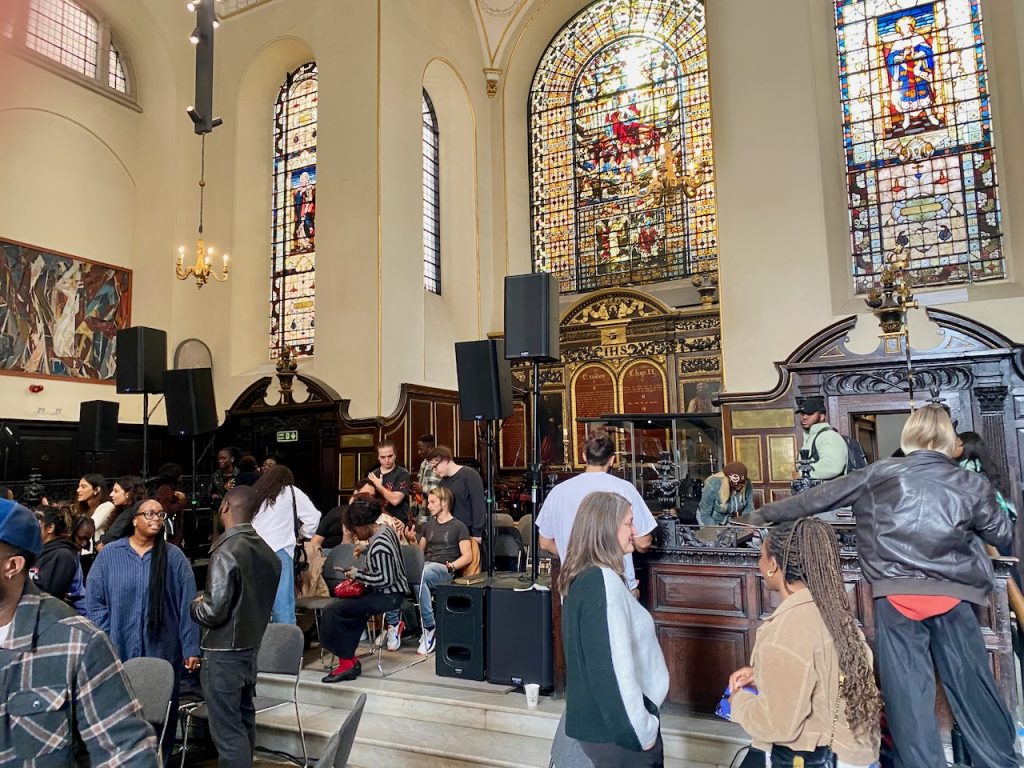
Inside, there is a lot of history, including a large stained-glass window above the altar. The main worship area is huge, especially when looking upwards. I had the impression the building was designed to make worshippers feel small! The leader and a small worship group were in the centre of the building with seats all around them. Extra seats were placed near the choir stalls. They were necessary.
Quiet Revival Experienced
When the service began, about 80 people were present, but it soon increased to around 140. However, it wasn’t the numbers that were significant; it was their ages. Most were under 35! Many were in their twenties. It was a predominantly young person’s service. Given that there were three other services that day, and one was billed as a youth service, this was a very young church. My wife and I stood out by a long way!
The service followed a standard charismatic pattern, starting with sung worship for the best part of an hour[7]. A reasonable number engaged in the worship, and those who did were very enthusiastic. However, many did not engage, as one would expect in a church that attracts the curious. The notices followed. These were lively as well, with overseas mission trips being advertised and the new church plant.
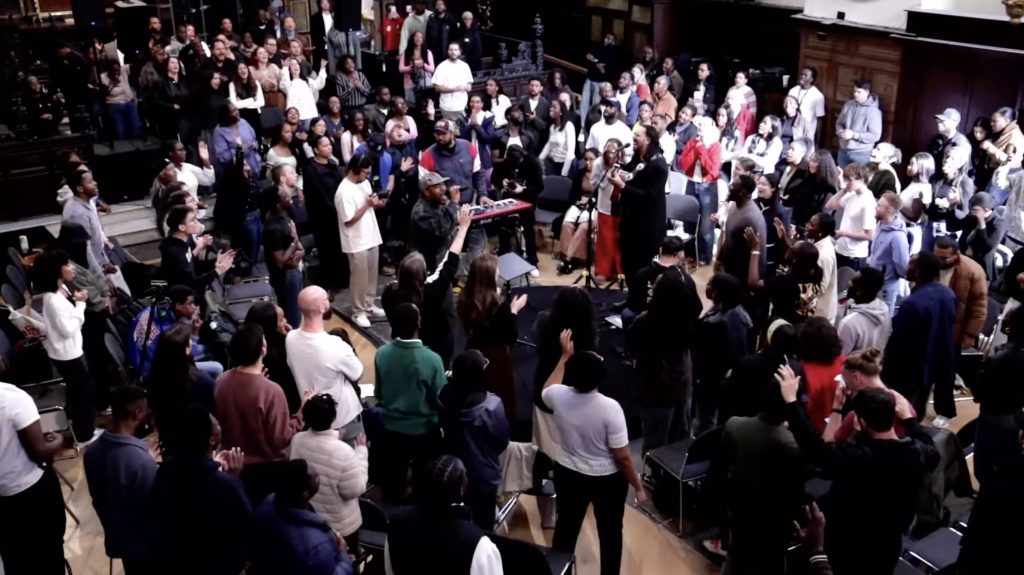
The rest of the service was devoted to a long teaching session, followed by some more sung worship and ministry at the end. This service was longer than their usual, lasting almost two hours. Few had left before the end, and no one seemed tired. I detected several spiritual conversations taking place. People seemed to have come to worship God. This was not a social occasion.
Was there a sense of an outpouring of the Spirit? If by “outpouring” is meant the suddenness of Pentecost, then no. However, dramatic events like that are rare even in the famous revivals. Most revivals have the ongoing presence of God in their worship and ministry, for those who wish to seek him. A characteristic of His presence is that it lingers after the event. Even days after, you find yourself dwelling on his love and mercy because of the time spent in worship. On that measure, yes, the Holy Spirit was moving in revival power at Imprint.
Enthusiasts
As I mentioned, not everyone present was engaging in worship. Indeed, I saw one young man recording parts of the service on his phone. One could be critical and ask why he was not concentrating on God. However, I thought to myself, he is going to show that to someone tomorrow. He may say, “Look where I was yesterday!” The other person will want an explanation. They may talk about Jesus. The other person may well be there next week, curious about why his friend is so excited. The man with the camera exemplifies the “enthusiast”—the one who passes the faith on to someone else[8].
If others in the church are also sharing what God is doing, and if God’s work is truly transforming people’s lives, then it is no surprise that the church is growing. That was the case in the New Testament church and in past revivals – but without the mobile phone!
Long-Term Revival
The service was billed as “contemporary”. By that, I am sure they mean it was not a traditional prayer book format interspersed with older hymns. Indeed, Imprint used songs written in the last ten years. However, the style of the service and the music was no different from what we were doing in the mid-nineties when I was playing electric guitar in a worship group. “Contemporary” has not changed much in thirty years[9]!
The style may not have changed much since the renewal of the 1990s, but one significant change has occurred. Few members of the Imprint congregation were born then, and among those who were, I doubt any were old enough to make a profession of faith. What is happening at Imprint and similar churches is a new generation reaping the benefits of the earlier work of the Holy Spirit. One sign of revival is that the Holy Spirit’s work is passed from one generation to the next. Revival has been gradually building over the decades.
I have previously argued that the Charismatic Renewal during the 1970s to 1990s was a revival. The churches involved grew as a result, but their growth was concealed by the much larger decline of their denominations. Now, the revival is reaching a younger generation again; the converts are younger, and the growth is becoming more noticeable.
Conclusion
Of course, I have only visited one church. A sample space of one is not enough to draw a conclusion! However, I have heard of similar congregations of young people. Although not enough to account for the data in the Quiet Revival, it does give some pointers to what may be happening in the UK at present.
Besides my personal experience, I have heard from several pastors about a rise in the number of young people attending church. It seems that there is more happening in this potential revival than just the Holy Spirit’s ongoing renewing work. There might be an awakening among those outside the church and even outside Christianity. I will look into this further in a future post.
For now, I am grateful to the people at Imprint Church London and very encouraged that the Lord is continuing to do wonderful things in the church and with a new generation of believers.
For the record, the “Quiet Revival” at Imprint was far from quiet!
References
- The Quiet Revival: Gen Z leads Rise in Church Attendance. The Bible Society, April 2025.
- The Quiet Revival – Why is it not Louder? Church Growth Modelling, 28 April 2025.
- You Don’t Measure Revival by Data. Church Growth Modelling, 3 July 2025.
- In one of my models, I describe the possible link between the work of the Holy Spirit in people and its subsequent effect on church growth. Growth in numbers follows growth in spiritual life. Modelling the Effects of the Baptism with the Holy Spirit.
- Imprint Church, London.
- New Wine was originally set up by Bishop David Pytches of St Andrew’s Chorleywood in 1989. The year previously, David Pytches helped our church find a Rector who was both evangelical and charismatic. He had been acting as a clearing house for Word and Spirit clergy on the move, and New Wine has captured that ethos of helping church renewal. They run an annual gathering at the Bath and Wells showground.
- The service is on the Imprint YouTube channel: Freedom: Overcoming Fear.
- See my post: “What is an Enthusiast?” for my definition and application of enthusiasts.
- The worship group I joined was experimenting with a rock format. I was able to inject blues, rock ‘n’ roll, and country styles into worship. I think we had much more freedom to experiment than worship groups nowadays. We had a large group that could rival a rock band! By contrast, Imprint had a smaller band and kept things simple. We may have been innovative, but I believe modern worship groups like Imprint have learnt from our mistakes and now do music more suitable for worship.
Tags: Enthusiasts, Imprint, London, Renewal
Having read your blog on your visit to ‘Imprint’. I was wondering what your views are as to what’ biblical gospel’ is all about. I just worry that in the evangelical/charismatic church will continue t focus on one aspect when, as the Lausanne Movement says ‘the Whole Church needs to take the Whole Gospel to the whole world’, the local congregation needs to cover all areas, not just personal issues. We need a way to have a theology with worship as the foundation (focusing on God’s Glory and Holiness, then going out to seek to help communities address the social issues of the day as advocates, and whilst doing that showing the relevance of the Bible helping people to come to a personal faith in Jesus, encouraging them to become part of a fellowship of believers, caring for each other who reach out in service to the local community and further afield, using their spiritual gifts and natural talents, identified through practical training in understanding the Bible and seeking to apply personally and in society., I know this is a long sntence but I hope it gives a brief framework for you give me your views. Thanks and God bless.
Thank you for your comment. Good question, which has taken me a while to think about.
My church growth models are based on the principle that Christians interact with non-Christians, with some of those interactions leading to conversion to the faith. Whether the interaction is classic personal evangelism or other forms of community engagement does not really matter. The distinction is too finely detailed for modelling. Also, there is very little data on the routes by which people come to faith or join churches. So even if I had models that distinguished different aspects of the gospel, I would have no way to validate them. So my thoughts on the Biblical gospel do not impact my modelling. Generic models are more useful with limited information.
The problem with trying to determine whether Christians engage in the social aspects of the gospel is that it is impossible to tell what church people volunteer for outside of church life. I know some churches believe that engaging with the community requires the local church to run its own social programmes. I have seen that a lot in the USA. However, there is an argument that such programmes are better run by non-church groups, with Christians participating like any other citizen. Having community work run by churches risks creating church silos and Christians spending all their time mixing only with each other. However, Christians joining secular groups can increase Christian/non-Christian contact and show Christians as part of the wider community. So, just because a congregation does not have programmes addressing social needs, it does not mean its members are not engaged with the social issues of their community.
When it comes to the gospel, I like what Philip said to Nathaniel in John 1: “We have found the one …. Jesus. Come and see”. It is simple to understand and within the reach of ordinary people. I understand why the people at Lausanne feel the need to investigate all aspects of the Gospel. But “the Whole Church needs to take the Whole Gospel to the whole world” sounds like management jargon or a political slogan. I did go and read the Lausanne article that explained it [1]. It is a bit intimidating! I am sure the Lausanne people mean well. However, this could feel like a heavy burden to a local congregation. But I think the local congregation would understand what happened to Philip and why he had to tell Nathaniel.
From my observations, the power of Christianity lies in local congregations, not in denominational structures or para-church organisations. At their best, they can empower congregations. At their worst, they develop a corporate mentality, a kind of religious elite, with their own agendas, and far removed from ordinary believers. My fear for evangelical and charismatic churches is not that they don’t cover all “aspects of the gospel”, but that they will become the next generation of corporate Christianity and stifle the work of the Spirit in the local congregation. At least in Imprint, they didn’t feel like Christians being stifled!
Hope this helps.
[1] https://lausanne.org/content/twg-three-wholes